 ChatGPT
 Perplexity
 Claude

Connect with us
Let's build something that scales. Reach out or follow along.
Dive into this week’s cheat code for builders
The D2C battlefield had two playbooks, Split the frontend. Stack the backend.
Plix dodged a compliance knockout by slicing its user experience into three focused frontends, all running on one powerful backend. Meanwhile, Amazon pumped ₹2,000 Cr into quick-commerce, Kiranas went digital, and ONDC picked up serious momentum.
Amazon, Swiggy, Kiranas, ONDC, and AR/VR are reshaping the stack
What started as a race for faster delivery is now a full-blown infrastructure shift. Logistics, distribution, and experience layers are being redefined in real time:
Amazon is investing $233M into dark stores, last-mile ops, and faster delivery systems across India.
The signal: Ecommerce infra is maturing—brands on Amazon can promise tighter SLAs without owning logistics.
Investor confidence rises as Swiggy’s food + commerce model sticks. Instamart is now a major D2C demand channel.
The signal: Quick-commerce is mainstream—especially for F&B brands needing rapid reach.
Kirana stores are modernizing with UPI and hyperlocal delivery to stay relevant.
The signal: D2C brands can now tap kiranas for low-CAC, last-mile delivery in Tier II/III cities.
With Amazon, Razorpay, and more joining, ONDC is becoming the neutral layer for open commerce.
The signal: Discovery, delivery, and payments are becoming modular—no longer tied to one platform.
Retailers are deploying AR/VR to cut returns and boost engagement in fashion and lifestyle.
The signal: 3D views, try-ons, and spatial UX are becoming conversion tools, not gimmicks.
Your Play: Build with APIs, automate ops, and optimize for discovery
A website warning led to a better, safer way to sell – and a big SEO win
A few weeks ago, the wellness brand Plix hit an unexpected bump. Some of its products, although designed with personalization in mind, were being purchased and consumed without the right recommendations. As you’d guess, not every product suits every person. This led to multiple complaints – serious enough that the health department stepped in.
The warning was clear: either remove non-compliant products or face a possible website ban. The case escalated with queries, reviews, and an exhaustive investigation. And while the science behind Plix’s offerings remained solid, the way they were presented online had become a problem.
So what did the team do? Instead of patching things over, they went back to the drawing board.
After internal discussions, compliance reviews, and tech consultations, Plix made a bold decision:
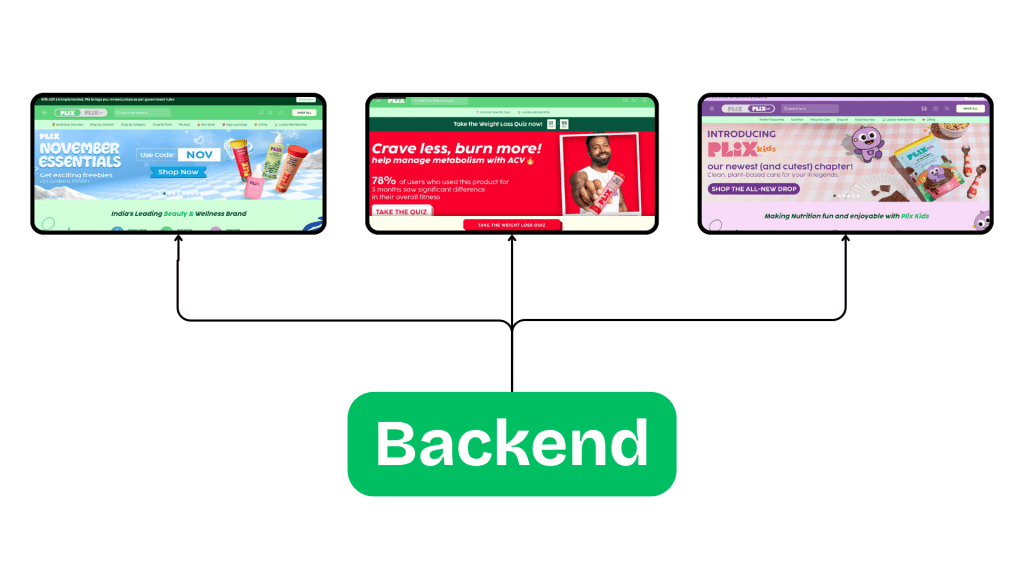
Split the user experience into three separate front-ends – Plix Life, Plix Quiz, and Plix Kids – while maintaining a single backend infrastructure.
Here’s the breakdown:
This structure allows Plix to control exactly what’s shown and sold on each platform. No more misaligned purchases or products appearing where they shouldn’t.
And there was another upside:
SEO got a major boost.
Previously, the overlap between products on Plix Life and Plix Quiz made it hard to rank well. With clear separation, each front-end now has a focused content and product strategy—making it easier for search engines to index and rank them properly.
What started as a compliance headache turned into an opportunity to rebuild smarter. The takeaway? Sometimes splitting your front-end is the best way to unify your backen — and your business.
Lesson: When scale meets regulation, rethink architecture. It’s not always about more code, it’s about better structure.
Founder’s POV: Why AEO is redefining how we build for discovery.
Is your site ready for AI-native discovery? Start thinking beyond keywords – optimize for answers.
That’s it for today. Got a build battle of your own? Send it in. We’ll break it down, Farzi-style.
Book a 1:1 chat, by filling out the form
Until next time, keep building smarter.
– Build Better by FarziEngineer



Comments are closed