ChatGPT
 Perplexity
 Claude

Structure Is the New Growth Lever
Acquisition is volatile. Attention is fragmented. But inside your store, growth is often hiding in structure, not new launches.
Summarize this post in AI's:
This week, we look at how reorganizing the same catalog unlocked deeper exploration, higher engagement, and smarter buying behavior for BoxUp.
D2C Pulse:
1. Performance Marketing Costs Are Climbing Again
News
Several D2C brands across beauty, wellness, and fashion are reporting rising CPMs and declining ROAS compared to late 2025, especially on Meta and Google.
Signal
Paid acquisition is becoming less predictable and more expensive, again.
Why It Matters
If your growth model depends heavily on paid traffic efficiency, your margins are fragile. Brands with stronger retention systems and higher AOV cushions will outperform those relying purely on ad arbitrage.
2. Brands Are Moving From Discounts to Structured Incentives
News
Instead of running flat 15–20% sales, more brands are introducing wallets, tier programs, bundles, and mix-and-match offers.
Signal
Operators are realizing that constant discounting conditions customers to wait, but structured incentives change buying behavior.
Why It Matters
The next phase of D2C growth isn’t about “bigger sal
3. Inventory Planning Is Becoming a Growth Lever
News
Brands are using demand signals (waitlists, notify-me data, variant preference tracking) to inform restocks and new launches more precisely.
Signal
Inventory decisions are shifting from reactive to data-led.
Why It Matters
When inventory matches real demand, brands reduce dead stock, increase sell-through speed, and improve cash flow, all without increasing ad spend.
4. Mobile Checkout Drop-Off Remains a Silent Killer
News
Internal audits across multiple mid-sized stores show that a large percentage of drop-offs still occur between cart and payment, especially on mobile.
Signal
The issue isn’t always traffic quality. It’s checkout friction.
Why It Matters
Improving checkout UX, nudges, wallet visibility, and payment clarity can often unlock more revenue than increasing traffic by 20%.
If growth is getting harder outside your store,
it’s time to optimize what happens inside it.
Structuring Luxury Without Limiting Choice – The BoxUp Rebuild
BoxUp didn’t have a product problem. They had a navigation problem.
Luxury gifting is inherently emotional. Customers don’t just browse for items, they browse for occasions, budgets, impressions, and intent. But when every product lives in a flat catalog, even premium brands risk overwhelming the buyer.
So instead of pushing more products, we redesigned how choice was presented.
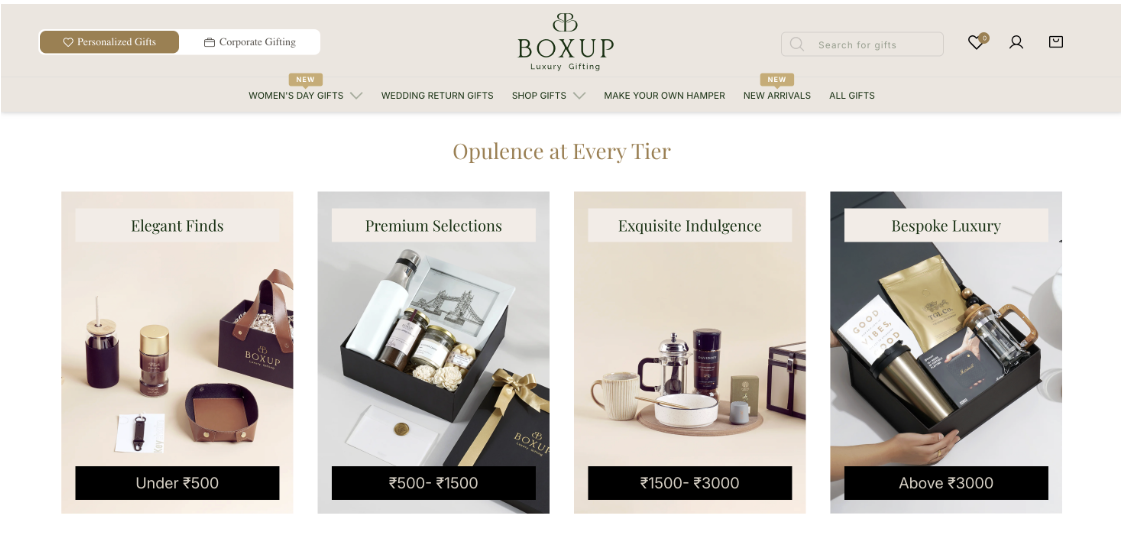
Opulence at Every Tier: Turning Price Into a Discovery Tool
We introduced the “Opulence at Every Tier” section, not as a filter, but as a psychological entry point.
Under ₹500.
₹500–₹1500.
₹1500–₹3000.
Above ₹3000.
Same catalog.
Different framing.
This simple structural layer did something powerful: it removed decision anxiety.
Luxury buyers often shop with a budget in mind but don’t want the experience to feel transactional. By visually segmenting collections into elegant price tiers, we allowed customers to self-qualify without feeling constrained.
Instead of asking:
“What can I afford?”
The interface subtly reframed it as:
“What level of opulence am I exploring today?”
That shift increased scroll depth, improved collection click-through rates, and made the browsing experience feel curated rather than crowded.
Make Your Own Hamper: Controlled Customization
The second layer was more strategic.
We built the “Make Your Own Hamper” section to balance freedom with structure. Customers could either select from curated bundles or build their own hamper from a defined range, maintaining pricing logic while expanding perceived control.
This wasn’t just, a customization widget. It was choice architecture.
By allowing customers to assemble their own hamper within guardrails, we achieved three outcomes:
First, exploration time increased. Users interacted more deeply with individual SKUs because they weren’t just evaluating one product, they were building an experience.
Second, average order values stabilized upward. When customers curate, they naturally justify incremental additions. The act of building increases perceived ownership, and ownership increases cart value.
Third, product overlap stopped feeling repetitive. The same SKUs that existed across collections now felt different depending on context, premium tier, curated box, or self-built hamper.
We didn’t add inventory.
We multiplied pathways.

The Unseen Performance Gains
What made this implementation particularly strong wasn’t just visible conversion metrics — it was behavioral shifts.
Bounce rates on category pages dropped because entry points were clearer. Heatmaps showed stronger engagement around pricing tiers. Customers spent more time interacting with the hamper builder than standard product listings.
Operationally, it also created intelligence.
We could now see:
- Which price tier attracted the most entry clicks.
- Which hamper combinations were most frequently built.
- Which products were consistently selected together.
That data began informing inventory positioning, bundle creation, and even homepage prioritization.
The “Make Your Own Hamper” feature quietly became a live demand-mapping tool.
The Bigger Lesson
Luxury isn’t about having more options. It’s about presenting options in a way that feels intentional.
With BoxUp, we didn’t introduce new products.
We restructured how customers approached the same catalog.
Price became navigation.
Customization became engagement.
And exploration became conversion.
That’s what building better looks like.
If your catalog feels crowded, flat, or hard to navigate, that’s not a design issue. It’s a growth constraint.
We help D2C brands restructure choice architecture to increase AOV, reduce friction, and surface demand signals hidden in plain sight.
Book a strategy call with FarziEngineer. and let’s turn structure into leverage.
Also read:
Growth Hides in Small Decisions
Why Retention is Winning in 2026?
The Gap Between Traffic and Trust