 ChatGPT
 Perplexity
 Claude


Acquisition is getting harder. Retention is getting smarter.
But one of the most overlooked revenue leaks happens at peak buying intent, when a product is out of stock.
This week, we look at how smarter intent capture turns missed sales into future conversions.
News
Multiple D2C operators are reporting flatter new-customer growth compared to 2024–25, while repeat revenue is contributing a larger share of total sales.
Signal
Growth is no longer being driven primarily by first-time buyers. The strongest brands are extracting more value from existing customers.
Why It Matters
If your business model depends heavily on constant new acquisition, you’re exposed. Retention systems, loyalty, bundles, subscriptions, wallets, personalized flows, are becoming the core growth lever, not a support function.
News
Brands across wellness, beauty, and supplements are experimenting with bundles, mix-and-match packs, and tiered rewards instead of flat 10–20% sitewide discounts.
Signal
Operators are realizing that pure discounting erodes margin without structurally increasing customer value.
Why It Matters
The smarter play isn’t “give 15% off.”
It’s redesigning how value is packaged so customers choose higher carts naturally. The future is incentive design, not coupon blasts.
News
Retention data from multiple mid-size brands shows higher engagement and faster repeat cycles on app push and WhatsApp flows compared to traditional email-only CRM.
Signal
Channels with immediacy and behavioral triggers are outperforming passive communication channels.
Why It Matters
Owning attention inside direct channels (app, wallet, messaging) gives brands more control over timing and behavior nudges, which compounds LTV over time.
News
Survey trends show shoppers increasingly expect tailored recommendations, dynamic bundles, and contextual offers, especially in health and lifestyle categories.
Signal
“Recommended for you” is no longer impressive. It’s expected infrastructure.
Why It Matters
Brands that don’t build adaptive systems risk looking generic. Personalization is shifting from marketing polish to revenue architecture.
So the question isn’t just how to drive more traffic.
It’s what happens when high-intent traffic hits a wall.
Smars Jewellery didn’t have a traffic problem. They had a timing problem. Customers were landing on product pages. They were interested. They were ready. But the product was out of stock.
And when jewellery is emotional, time-sensitive, or gift-driven. “Out of stock” doesn’t mean, “I’ll come back later.” It often means – “I’ll buy something else.”
Out-of-stock pages usually do one of three things:
But email capture has friction.
And jewellery purchases are often impulsive or occasion-driven.
So we asked:
What if the notification didn’t have to go to you?
Jewellery isn’t always self-purchase.
Sometimes:
Why force the notification to only one email field?
We built a lightweight plugin that sits directly on product pages.
When an item is out of stock, customers can:
That’s it.
No account creation, no login, no complicated forms.
Just: “Notify this number when available.”
Phone numbers convert better than email in mobile-first commerce.
This removed:
It made intent instant.
Traditional back-in-stock = one person.
This system allows:
The product doesn’t just notify a buyer.
It activates a network.
Now Smars doesn’t just see:
“Product out of stock.”
They see:
This informs:
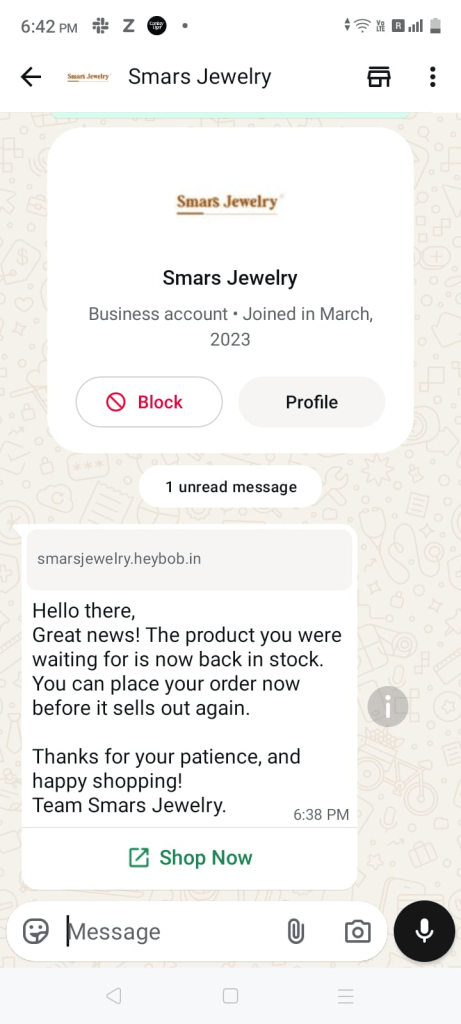
Instead of losing warm traffic, Smars now:
The product page stopped being a dead end.
It became a pipeline.
Most brands treat out-of-stock as a temporary inconvenience. But it’s actually a moment of maximum intent. If you don’t capture that moment, someone else will.
Building better isn’t always about driving more traffic. Sometimes it’s about respecting the traffic you already have.
If your product pages are leaking intent during stock-outs,
we’ll audit it.
We’re offering a free retention + conversion analysis to identify silent revenue gaps in your store.
Schedule your free strategy call with FarziEngineer and let’s plug the leak before you spend another rupee on ads.



Comments are closed