 ChatGPT
 Perplexity
 Claude


This edition brings you the key shifts shaping digital commerce today, followed by a real-world look at how a luxury brand(Rose The Watch Bar) redesigned its online experience for deeper engagement. A blend of insights and execution, what’s changing, and how smart brands are responding.
Amazon announced plans to invest over $35 billion in India over the next few years, aiming to expand operations and boost its AI, logistics and fulfilment capabilities nationwide.
Signal: Global ecommerce giants are doubling down on India, not just as a marketplace, but as a full-stack tech & retail infrastructure play.
Why it matters: Faster delivery, smarter backend, and improved fulfilment mean better reliability and reach for D2C brands, especially those relying on marketplace or omnichannel distribution.
Meesho’s IPO was fully subscribed and the listing day soared ~46% above issue price, reflecting strong investor confidence in its asset-light, value-driven marketplace model.
Signal: Value-first, mass-market e-commerce platforms are still viewed as high-potential plays by capital markets.
Why it matters: For small-to-mid D2C brands, this signals investor appetite and consumer demand for budget-friendly, high-volume products. It’s a reminder that the “value + volume” model still works in 2025.
Blinkit’s leadership signaled upcoming shifts in user-experience and discounting strategies, acknowledging that many smaller competitors may not survive the upcoming consolidation round.
Signal: Quick-commerce space is stabilizing. Leaders are consolidating power; competition may thin out.
Why it matters: For D2C brands, partnering with stable quick-commerce providers (vs spread-thin startups) reduces fulfilment risk and ensures better delivery SLAs during high-demand periods.
Conscious Chemist, a niche D2C skincare label, secured fresh funding, preparing for its next growth leg in 2026 with expansion and product launches.
Signal: Investors continue to back niche, premium and clean-label D2C consumer brands, especially in beauty & wellness.
Why it matters: For emerging D2C brands in personal care, this shows that growth capital is still accessible, provided you have product differentiation and clear brand positioning.
Samsung’s deal with Instamart ensures that customers in major cities can get smartphones, wearables, and accessories delivered within 10 minutes.
Signal: Even large electronics brands are embracing quick-commerce delivery, not just essentials or FMCG.
Why it matters: The expectation for 10–15 minute delivery windows is becoming mainstream. D2C brands across categories, from beauty to electronics, need to prepare logistics accordingly or risk falling behind.
Now that we’ve unpacked what’s changing in the broader landscape, let’s shift from trends to real transformation.
Here’s how one luxury brand applied these principles, crafting a digital experience that feels less like “shopping online” and more like stepping inside a curated horology salon.
When Rose The Watch Bar approached us, they had a clear vision:
Create a digital space that feels like entering a high-end horology showroom, without turning the website into a simple e-commerce catalog.
Their challenge wasn’t just selling watches.
It was showcasing heritage, rarity, and craftsmanship in a way that encouraged exploration first, and purchasing second.
Luxury watch buyers behave differently from typical online shoppers.
Many models aren’t meant to be “Add to Cart” items. They’re meant to be admired, compared, and requested, especially those with limited availability or collector-grade value.
Rose The Watch Bar wanted a Shopify experience that could balance three different buyer journeys:
Blending all three into a single, intuitive Shopify flow, without confusing users or diluting the premium feel, was the real challenge.
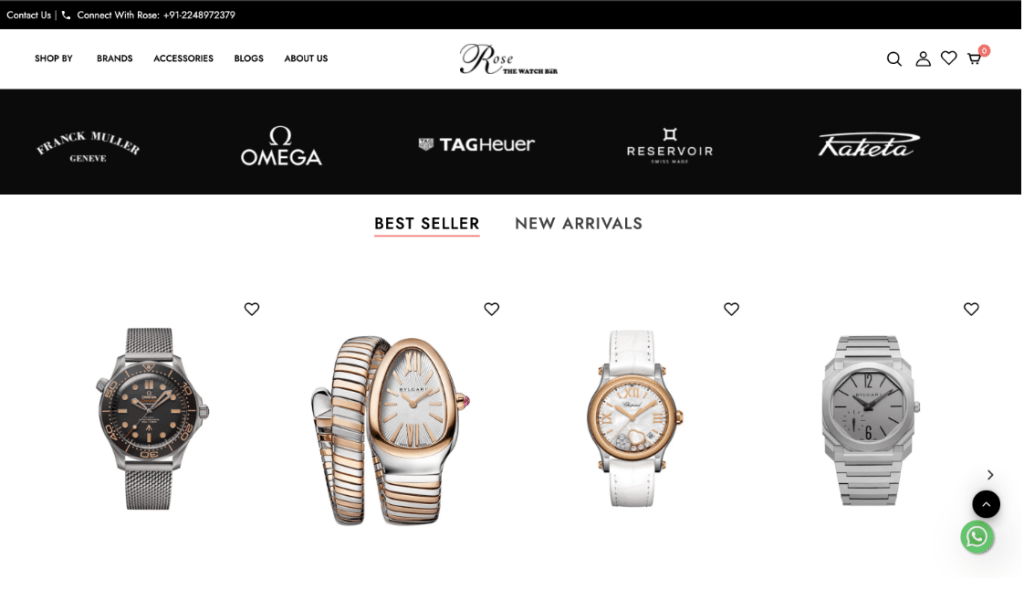
We rebuilt their Shopify experience around decision psychology and luxury UX patterns:
Each watch category was mapped with its own interaction model.
– Showcase Pieces: High-resolution imagery, full 360° view, no price tags, created a museum-like aura.
– Request an Offer: Custom form integrating with their CRM to trigger personalised quotes.
– Direct Purchase: Standard Shopify checkout, but with refined UI to maintain the luxury tone.
Instead of pushing users toward checkout, we built a rhythm of exploration:
heritage notes, brand history, movement details, and lifestyle imagery that kept users browsing.
Most luxury buyers don’t convert immediately.
So we introduced soft-conversion touchpoints, wishlists, enquiry forms, and follow-up automations. turning casual viewers into warm leads.
Within the first 30 days:
And most importantly, Rose The Watch Bar now stands out as a luxury horology destination, not just a store.
This case study proves that e-commerce doesn’t always mean “add to cart.”
For luxury brands, the real value lies in building desire, trust, and dialogue.
By blending retail and showroom experiences into one seamless Shopify journey, Rose The Watch Bar achieved something rare, a digital store that feels personal, curated, and deeply premium.
We’ve put together a CRO + Business Audit tailored specifically for your brand, highlighting quick wins, revenue opportunities, UX leaks, and long-term growth levers.
If you’d like us to walk you through the full breakdown, you can schedule a conversation with our team.
Build Better by FarziEngineer
→ Book a strategy session & explore your audit in detail, just by filling out this form



Comments are closed