 ChatGPT
 Perplexity
 Claude

Connect with us
Let's build something that scales. Reach out or follow along.

A strong conversion rate optimization strategy isn’t always about more traffic or more products. Sometimes it’s about reducing friction at the very first click. This week, we explore how brands are improving conversions through structure, segmentation, and smarter customer pathways, and how a simple toggle reshaped buying behavior at BoxUp.
Summarize this post in AI's:
1. Brands Are Prioritizing LTV Over Pure Revenue Growth
News
More D2C founders are shifting focus from topline GMV growth to improving Lifetime Value (LTV) and contribution margins.
Signal
Sustainable growth is replacing vanity growth.
Why it matters
Revenue without retention is rented. Brands optimizing for LTV build predictable cash flow, stronger margins, and lower dependency on paid acquisition.
2. Conversion Rate Optimization Is Outperforming Traffic Scaling
News
Improving conversion rate by even 0.5–1% often generates more profit than increasing traffic by 20%.
Signal
Scaling broken funnels is expensive.
Why it matters
Before increasing ad budgets, brands are fixing checkout UX, bundling logic, and friction points. Optimization is becoming the new acquisition.
3. Smart Bundling Is Replacing Static Product Pages
News
Brands are shifting to mix and match packs, guided bundles, and curated collections.
Signal
Customers respond better to structured choices than endless catalogs.
Why it matters
Bundles increase AOV, improve perceived value, and simplify decision making without relying on discounts.
4. First Party Data Is Becoming a Competitive Advantage
News
With rising acquisition costs and platform volatility, brands are strengthening owned channels, apps, wallets, CRM automation, and loyalty infrastructure.
Signal
Customer data is now strategic.
Why it matters
Owning data enables personalization, better forecasting, and repeat revenue without reacquisition. If customers think differently, why should they shop the same way?
Luxury gifting has two very different buyers. One shops for emotion.The other shops for scale.At BoxUp, both entered the same storefront. That created friction. Corporate buyers don’t browse like personal shoppers. Personal shoppers don’t think in bulk.
The Core Problem: Mixed Intent, Single Experience, Two different mindsets. One journey. The store tried to serve both. Messaging blurred. Navigation slowed decisions. When intent isn’t clear, users hesitate. Hesitation kills conversion.
Instead of rebuilding everything, BoxUp introduced a top level switch:
Personalized Gifts ↔ Corporate Gifting
Not a design tweak. A journey decision. Users define intent upfront. The experience adapts accordingly. Same backend. Same inventory. Different pathway.
What Changed: Clarity Reduced Friction Users stopped guessing if the store was for them. Corporate buyers saw structure.
Personal buyers saw curation.
As a result:
The store felt intentional.
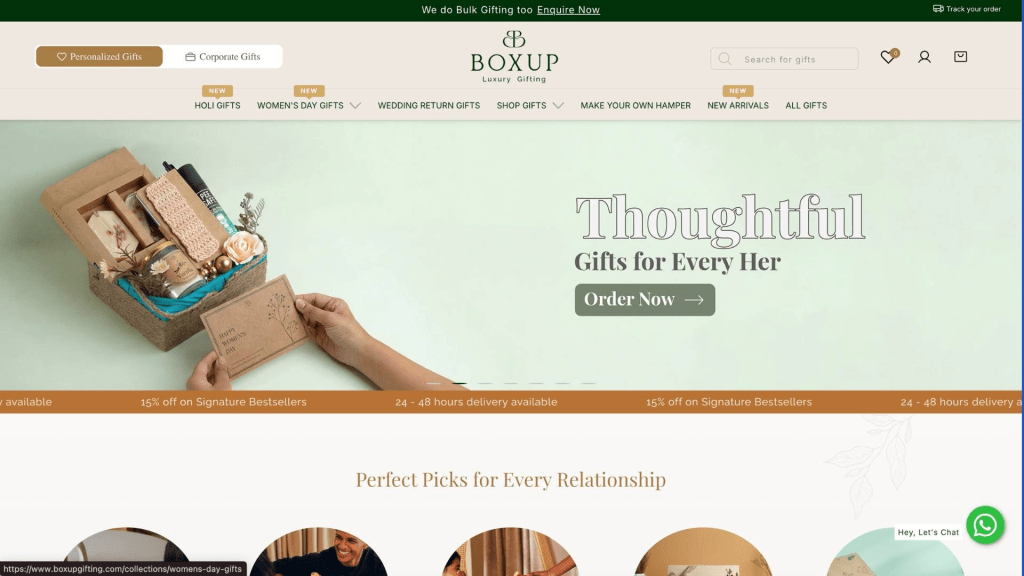
The toggle didn’t just improve UX. It separated behavior.
Now BoxUp could see:
One store became two clear datasets.
Better inputs → better decisions.
Growth isn’t always about more. Sometimes it’s about making things easier to understand.
BoxUp didn’t add products.
They didn’t increase spending.
They aligned the structure with the intent. That’s a conversion rate optimization strategy in practice.
If your store serves multiple buyer types but treats them the same, you’re leaving conversions on the table. We help brands turn structure into a conversion rate optimization strategy.
Book a strategy call with FarziEngineer and let’s turn structure into growth.
Also read :
sustainability is scaling trust isnt
boxup customer navigation system
jewelleryr retention strategy

© 2026 Creesync Software Technologies Pvt Ltd



Comments are closed