 ChatGPT
 Perplexity
 Claude

Connect with us
Let's build something that scales. Reach out or follow along.

And that gap is where most direct-to-consumer (D2C) brands will quietly lose.
India’s e-commerce sector is growing rapidly, expected to surpass $200B by 2026 and move toward $700B long term. Sustainability is no longer niche; it’s becoming the default. 73% of consumers prefer sustainable brands. But preference without trust doesn’t convert; it just increases skepticism.
That’s the real problem. Everyone is saying the same thing, but very few are proving it. Across D2C, sustainability has turned into a script. Every brand claims to be “eco-friendly,” “conscious,” or “green.” But customers are no longer buying words; they’re rejecting unverifiable claims. If the impact isn’t visible, it simply doesn’t exist. And right now, for most brands, it doesn’t.
GOVERNMENTS ARE STARTING TO CRACK DOWN ON “GREEN CLAIMS”
Regulators across global markets (EU, UK, and now early signals in India) are tightening rules around misleading sustainability claims, with brands being required to prove environmental impact instead of just stating it.
Signal
“Sustainable” is no longer a free marketing word.
It’s becoming a compliance layer.
Why it matters
Brands won’t just lose trust for vague claims; they risk penalties, takedowns, and credibility damage.
Which means:
Sustainability is shifting from:
→ Storytelling
To:
→ Verifiable proof systems
This shift isn’t coming. It’s already happening. Brands are moving from saying impact to showing it.
And that’s where real differentiation is emerging.
Not in better messaging.
Not in better ads.
But in the systems built behind the promise.
Plix didn’t try to sound more sustainable. They made sustainability traceable.
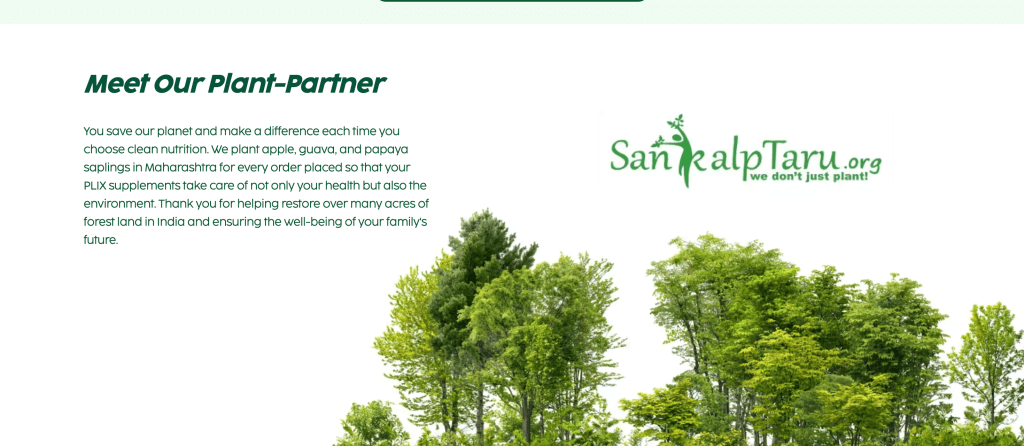
“Plant a tree on every order” sounds powerful, but this is where most brands fail. The same proof is reused; there’s no uniqueness and no real sense of ownership. To the customer, it feels generic.
When every brand plants “a tree,”
No one remembers which tree was theirs
Plix already had scale lakhs of trees, each with an image, location, and metadata. The missing layer was the connection.
So we built a mapping system:
No duplication. No repetition. No pattern. Just a system that keeps the experience real, even at scale.
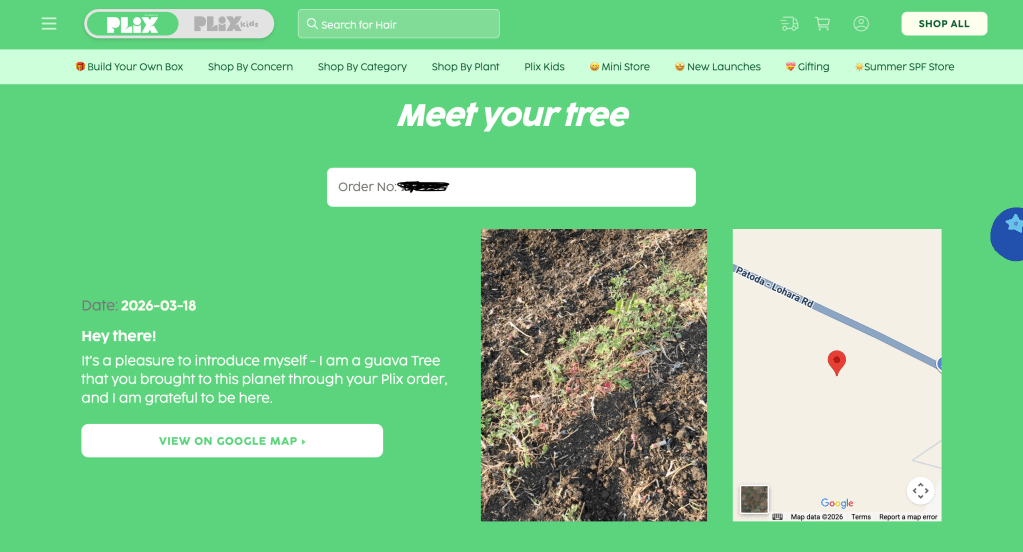
Now the customer doesn’t see a promise; they see proof. A tree, a location, a reference tied directly to their order. It shifts from a claim to an outcome. And in that moment, it stops being marketing and starts feeling personal.
That’s where belief is created.
This isn’t sustainability, this is trust infrastructure.
This doesn’t rely on discounts or ad pushes. It builds value directly into the experience.
The result is simple but powerful: stronger recall, higher trust, and lower dependency on discounts. Retention shifts from being offer-driven to emotion-driven, powered by something customers can actually see and believe.
We’re entering a new phase where claims won’t convert proof will. If users can’t see the impact, they won’t value it. If it doesn’t feel personal, they won’t remember it. And if it’s not systemized, it won’t scale.
This is no longer a branding choice. It’s a competitive advantage.
The next set of winning brands won’t just sell better products. They’ll build systems that prove value. And that’s where real differentiation will come from.
We don’t ship features. We build belief systems.
If you’d like us to walk you through the insights and break them down for your business, you can schedule a quick call using the form below.
Book a Strategy Call with us. Just fill out this form
Build Better by FarziEngineer
Turning D2C signals into scalable systems.



Comments are closed