ChatGPT
 Perplexity
 Claude


POV: 60% of Indian D2C orders are COD. 30% of them never get accepted.
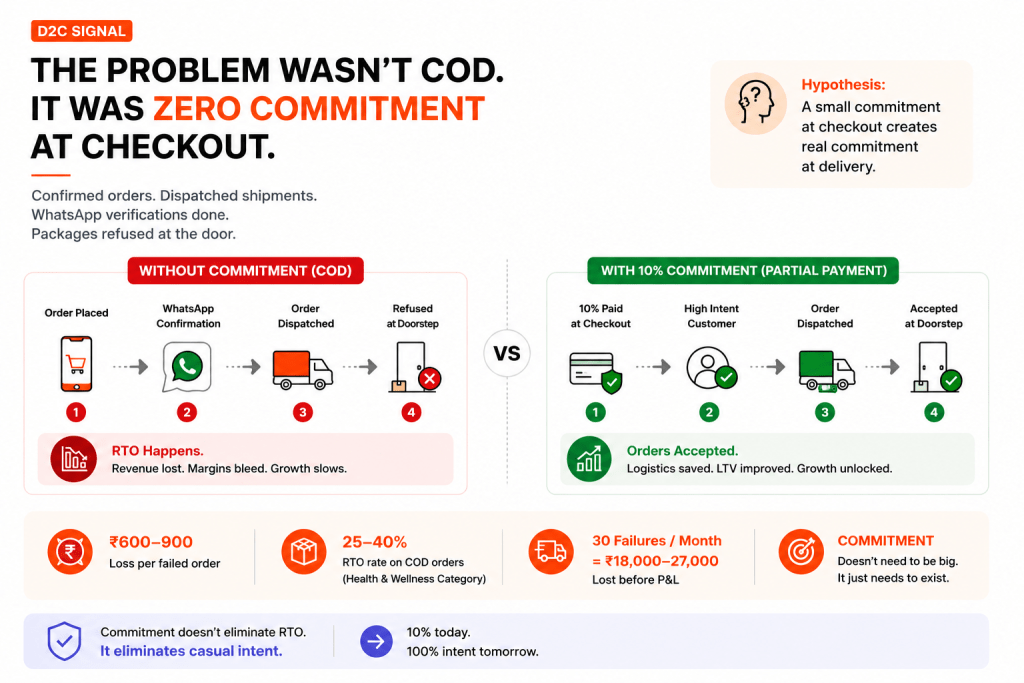
That’s not a delivery problem. That’s a revenue leak hiding in plain sight.
The average RTO on a ₹6,700 COD order costs a brand ₹180–320 in forward logistics, ₹150–250 in return logistics, plus the ad spend that brought that customer in.
Total damage per failed order: ₹600–900. With zero sales.
Do that 30 times a month and you’ve quietly lost ₹18,000-27,000 before you even look at your P&L.
In this edition
- D2C Signal: COD is driving growth and quietly killing margins
- Case Study: How partial payment reduced high-ticket RTO risk
- Decode: Why a 10% commitment changes customer behavior
D2C PULSE
Shopify reported RTO rates of 25-40% on COD orders in India’s health and wellness category.
Signal: High-ticket COD is the single biggest silent revenue leak in Indian D2C.
Why it matters: Most brands track CAC obsessively. Almost no track true RTO cost per order. If you haven’t done that math yet, do it today.
Zepto and Blinkit are pushing D2C brands toward prepaid only listings for high-value SKUs.
Signal: Quick commerce figured this out already. Prepaid filters intend at the source.
Why it matters: If a customer won’t commit ₹500 upfront on a ₹5,000 order, they were never really buying.
What We Built
A brand was losing revenue on high-ticket COD orders consistently. Confirmed orders. Dispatched shipments. WhatsApp verifications done. Packages refused at the door.
The problem wasn’t the customer. It was zero commitment at checkout.
We integrated a partial payment feature directly on Shopify.
The logic is simple:
Order above ₹3,500 → customer pays 10% advance at checkout → rest collected on delivery.
On a ₹6,700 order, that’s ₹670 upfront. Not painful for the customer. But enough to signal real intent.
What changed:
RTO on high-ticket orders dropped sharply. Customers who paid even a small advance showed up at the door. Brands stopped bleeding on logistics, return freight, and wasted campaign spend.
The insight: Commitment doesn’t need to be full payment. It just needs to exist.
One Thing Worth Knowing
Partial payment isn’t a new concept. Hotels have used it for decades. D2C brands are just late to apply it.
The ₹3,000-₹8,000 order range is where RTO hits hardest, big enough to hurt the brand, small enough that customers hesitate on full prepay. 10% advance solves both sides of that equation cleanly.
Worth Reading
Shiprocket’s RTO Report breaks down return rates by category, order value, and pin code. Useful benchmark if you want to know where you actually stand.
If RTO is quietly eating your margin, happy to walk through how this works on your stack.
Reply or reach out, no pitch, just a conversation.
Talk to us: https://farziengineer.com/contact-us/?utm_source=newsletter&utm_medium=email&utm_campaign=25
Explore more:
Previous insight →[ your Shopify store is not a competitive advantage],[Conversion-rate-optimisation-strategy], [Sustainability is scaling. Trust isn’t.]
built for operators, not audiences.