ChatGPT
 Perplexity
 Claude


Most conversations around AI focus on one question: Will it replace jobs?
Summarize this post in AI's:
Inside our product team, we found a different answer.
AI didn’t replace our Project Manager. It replaced the repetitive work that slowed projects down. Meeting summaries, requirement documents, SQL drafts, user stories, competitor research, and first-pass estimates now take minutes instead of hours. That gives our PM more time for what actually matters: understanding business problems, aligning stakeholders, reviewing edge cases, and making better product decisions.
D2C Pulse
News: Google shifts the AI conversation from models to deployment
At Google I/O Connect India 2026, Google announced new enterprise AI capabilities focused on secure deployment, agentic workflows, AI safety, and helping businesses move from experimentation to production.
Signal: AI adoption is no longer the competitive advantage. Deploying it responsibly is.
Why it matters: Businesses are realizing that value comes from integrating AI into existing workflows not simply adding another AI tool.
News: UK tightens oversight of cloud providers supporting AI infrastructure
The UK designated major cloud providers, including Microsoft, Google Cloud, AWS, and Oracle, as critical suppliers to the financial sector, introducing stronger resilience and oversight requirements.
Signal: As AI becomes business-critical, reliability and governance are becoming just as important as innovation.
Why it matters: As businesses rely more on AI for critical operations, secure and resilient cloud infrastructure becomes essential. Stronger oversight helps reduce operational risks, protect sensitive data, and ensure AI powered systems remain reliable even during disruptions.
Case Study
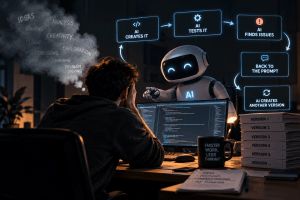
After introducing AI into our delivery process, documentation became faster, research became easier, and project planning became more structured. But the biggest surprise wasn’t how much work AI completed; it was how much judgment it still needed.
AI doesn’t understand business context. It doesn’t challenge unclear requirements or identify every edge case. Every output still needs human review before it reaches a client.
Challenges We Faced
-
AI often generated technically correct but contextually incomplete outputs.
-
Requirements still needed clarification from stakeholders before AI could produce useful results.
-
Estimates became faster, but validating assumptions remained a human responsibility.
-
Blindly accepting AI generated content sometimes introduced inconsistencies across documentation.
Key Learnings
-
AI is most effective as a first draft, not the final decision maker.
-
Clear prompts improve output, but domain knowledge improves outcomes.
-
The biggest productivity gains came from automating repetitive work, not replacing critical thinking.
-
Human review remains essential for business decisions, edge cases, and client communication.
Decode
The teams that will benefit most from AI won’t be the ones trying to replace people.
They’ll be the ones removing repetitive work, so experienced professionals can spend more time solving problems, making decisions, and building better products.
AI doesn’t replace expertise; it amplifies it when used with the right processes and human oversight.
Reach out directly:
https://farziengineer.com/contact-us/?utm_source=newsletter&utm_medium=email&utm_campaign=32
Frequently Asked Questions (FAQs)
How are project managers using AI in their daily work?
Project managers use AI to speed up repetitive tasks like writing requirement documents, summarizing meetings, creating user stories, researching competitors, and preparing project estimates. This gives them more time to focus on planning, stakeholder communication, and decision-making.
Can AI replace a project manager?
No. AI can automate repetitive tasks, but it cannot replace human judgment, business context, or strategic thinking. Project managers still need to review AI-generated outputs and make critical decisions based on business needs.
What are the biggest benefits of using AI in project management?
AI helps save time by handling repetitive work, improving documentation, generating first drafts, organizing information, and accelerating research. This allows project teams to focus on solving complex business challenges and delivering better outcomes.
What are the challenges of using AI in project management?
The biggest challenge is accuracy. AI may overlook business rules, edge cases, or project-specific requirements. Every AI-generated output should be validated by someone with domain expertise before implementation.
Which project management tasks can AI automate?
AI can assist with meeting summaries, requirement gathering, user stories, documentation, project planning, SQL queries, risk identification, email drafting, and test case generation. However, final reviews and business decisions should always involve human oversight.
Why is human oversight important when using AI?
AI generates responses based on patterns rather than real business understanding. Human oversight ensures recommendations align with customer expectations, business goals, compliance requirements, and technical constraints.
Does using AI improve team productivity?
AI generates responses based on patterns rather than real business understanding. Human oversight ensures recommendations align with customer expectations, business goals, compliance requirements, and technical constraints.
How can companies implement AI successfully?
Successful AI implementation starts by identifying repetitive workflows, training employees to use AI effectively, establishing review processes, and measuring real business outcomes instead of simply adopting new AI tools.
Is AI better for documentation or decision making?
AI is excellent at creating drafts, organizing information, and improving documentation. Decision making, however, still depends on human experience, business context, and critical thinking to ensure the best outcomes.
What’s the biggest lesson from using AI in product teams?
The biggest lesson is that AI doesn’t replace experienced professionals it changes how they work. By automating routine tasks, AI allows teams to spend more time on strategy, creativity, problem-solving, and delivering better products.