ChatGPT
 Perplexity
 Claude

Quick answer: FarziEngineer built Plix’s ecommerce website and continues to maintain it. It is a Shopify Plus store with a custom headless frontend, three websites on one backend, and Android and iOS apps. If you are searching for the best Shopify website in India, it is a strong example of what “good” looks like, and this post shows why.
Summarize this post in AI's:
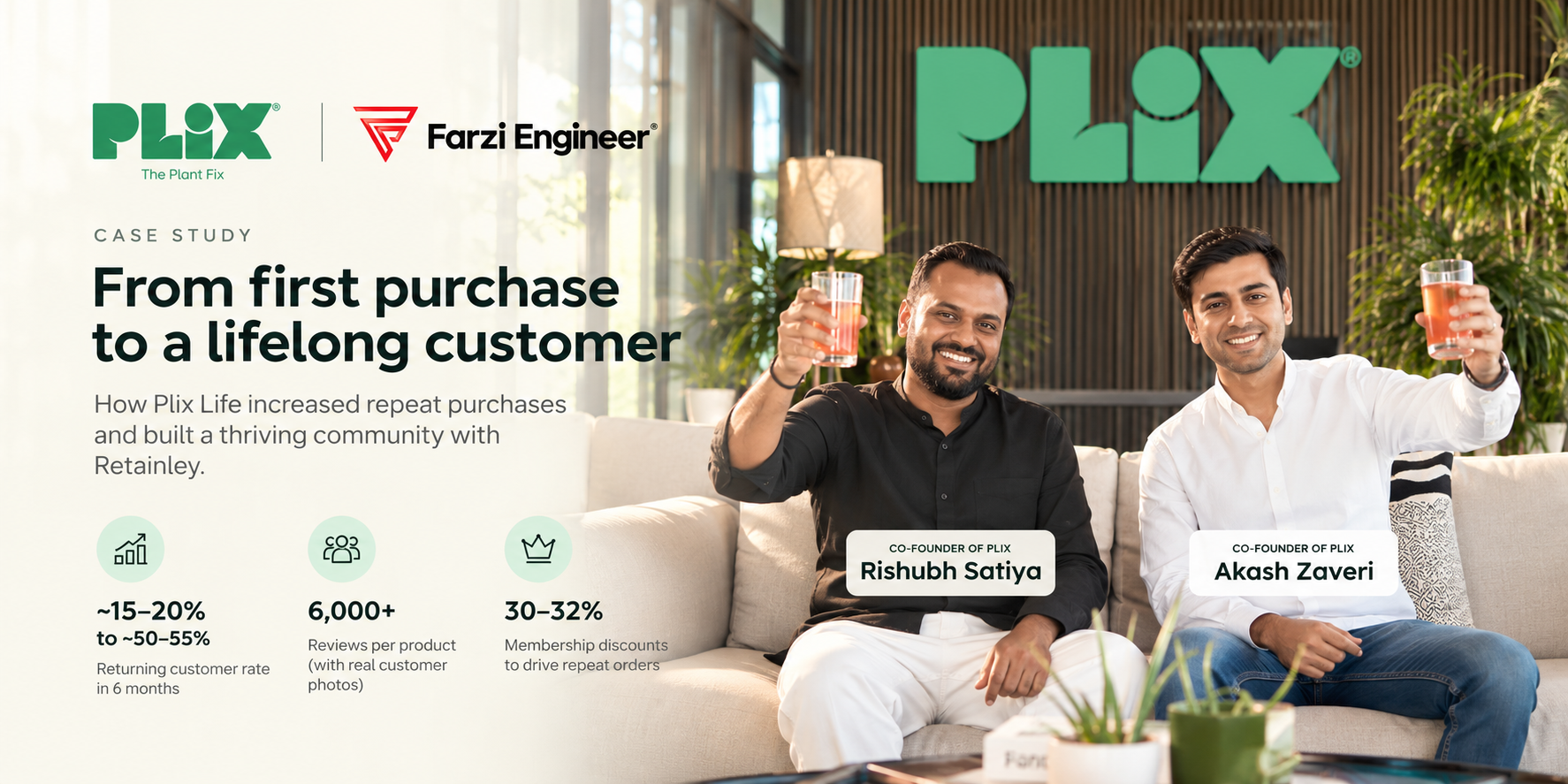
Plix’s founders once described their own website in one word: jerky. Today the brand runs three websites, two apps and a tech stack that handles loyalty, bundles, an AI quiz and warehouse integrations, all from one backend. This is the story of how that happened, what it changed, and what it takes to build a Shopify Plus website that can stand among the best in India.
📌 TL;DR
FarziEngineer developed and maintains the ecommerce website for Plix Life, the plant-based nutrition and personal care brand also known as Plix – The Plant Fix.
The old store was slowed down by plugins. We kept Shopify Plus as the engine and built a custom headless frontend with an app-like feel.
Results from our project records: 87% conversion improvement, 25% higher average order value, 10 lakh+ app downloads and a 4.9 app rating. Plix’s founders also reported a 30% conversion lift within 7 days of launch and page loads under one second.
There is no official ranking of India’s best Shopify website, so we share a seven-point checklist you can use to judge any store, and show how Plix measures up.
We have worked with Plix for 4+ years, alongside brands like Mamaearth, boAt, YogaBar, Minimalist and Perfora.
The problem: a store that felt jerky
Plix sells plant-based supplements and personal care, and a lot of its customers shop on their phones. Shoppers expect an app-like experience: instant taps, smooth scrolling, no waiting.
The store they had was built the way most Shopify stores grow: one plugin for this feature, another for that one. Each plugin added scripts, and the site got heavier and less stable with every addition. Plix’s founders, Rishubh Satiya and Akash Zaveri, described it plainly:
“With a lot of plugins, my website was jerky and I was not able to provide a stable app-like experience on my website.”
Rishubh Satiya and Akash Zaveri, Founders, Plix
That is a common trap for fast-growing D2C brands. The tools that helped you grow start to slow you down. So the question became: how do you keep everything Shopify is good at, without the drag?
The decision: keep Shopify Plus, replace the storefront
The answer was headless commerce. In simple terms, the backend (products, orders, customers) stays on Shopify Plus, while the part shoppers see is rebuilt as a custom frontend. You get Shopify’s reliability behind the scenes and full freedom over speed and design in front. The setup has three parts:
- Custom frontend: the fast, app-like shopping experience and custom user journeys.
- Shopify Plus backend: products, customers, orders and core ecommerce operations.
- Connected systems: inventory, checkout, CDN, analytics and operational tools.
The founders put it this way: they reached out to us, we helped set up the new website, and the main constraint of the old store, Shopify’s limits on customisation and custom flows, went away. This is the kind of work our Shopify development services cover, from Shopify Plus builds to headless storefronts.
“I reached out to the guys at farzi who helped me set up my new website.”
Rishubh Satiya and Akash Zaveri, Founders, Plix
In their words, “Shopify had limitations of making customisations and creating flows on the website which custom frontend had enabled.” The first result came fast: within 7 days of launch, they reported a 30% improvement in conversion rate, and page load time dropped to under one second.
The build: three websites, one backend
Once the foundation was right, Plix could grow without rebuilding. Today, three websites run on a single backend:
- plixlife.com: the main store for nutrition, skincare, haircare and body care.
- kids.plixlife.com: a dedicated store for Plix Kids.
- The Build Your Own Box site: a dedicated bundle-building experience.
One backend means one set of products, orders and customers to manage, however many storefronts sit on top. Our work includes the headless commerce build, UI/UX design, ongoing maintenance and a dedicated tech team for Plix.

The features that make Plix feel different
A fast storefront is only the start. With a custom frontend, we could build the flows a wellness brand actually needs, instead of squeezing them into plugins:
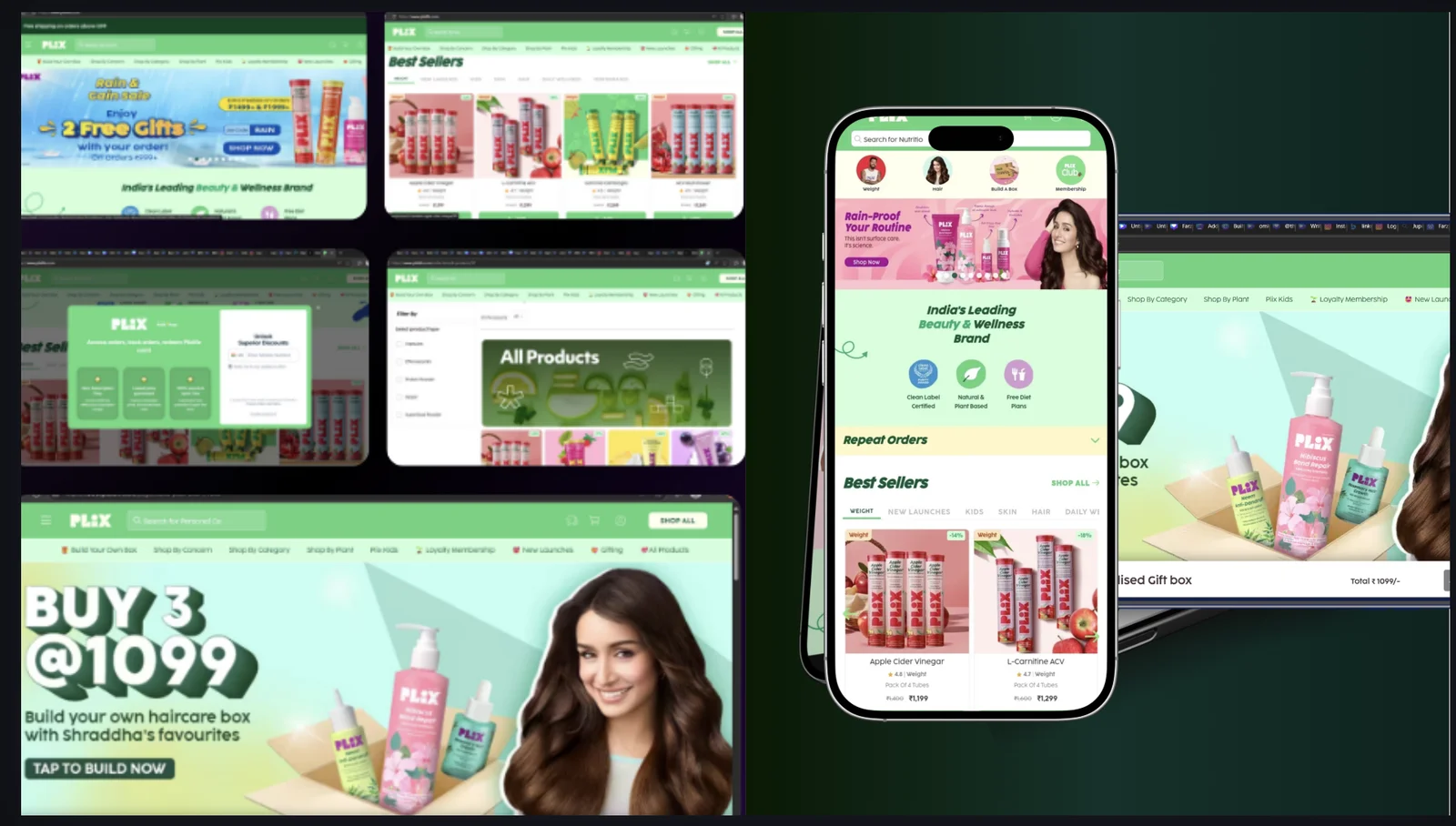
- Build Your Own Box (four variants): shoppers pick their own products at a fixed bundle price, which lifts basket size. You can see boxes of four, five and mini sets on the live store.
- Cashback and loyalty system: a wallet, cashback and membership that give customers a reason to come back.
- Custom cart and discount logic: offers like “Buy 3 at ₹1,099” that standard Shopify discounts cannot handle cleanly.
- AI product recommendation quiz: helps a shopper who does not know where to start find the right product.
- Analytics tool and custom OMS: in-house reporting and order management built around how Plix actually operates.
- Shop your way: by concern (weight, hair growth, acne, pigmentation), by category, or by plant ingredient such as guava, jamun, rosemary and pineapple.
Plugged into the way Plix runs
A website is also a link in a chain of tools. We implemented and connected the systems behind it:
- Unicommerce: order and inventory management behind the store.
- GoKwik: checkout and conversion tooling.
- N7 CDN setup: faster delivery of pages and images to shoppers.
- Firework: shoppable video on the store.
What makes a Shopify Plus website the best in India?
There is no official ranking of India’s best Shopify website, and any list that claims one is an opinion. So instead of naming a winner, here is a checklist you can use to judge any Shopify or Shopify Plus store, and how Plix scores on each point. We built Plix, so we are not neutral. Use the list to judge for yourself.
- Speed on mobile. Pages should load in three seconds or less on a normal Indian mobile connection, and the best stores aim for about one second. Plix’s founders report page loads under one second after the rebuild.
- An app-like feel. Instant taps, smooth scrolling and no jerky layouts. This was the exact problem Plix’s founders wanted to fix.
- Freedom to build custom flows. Bundles, tiered offers and quizzes that standard themes cannot do. Plix runs Build Your Own Box, custom cart logic and an AI recommendation quiz.
- Built for repeat purchase. Loyalty, cashback, membership and easy reordering, not just a good first visit.
- Connected to operations. Clean links to inventory, checkout and logistics tools such as Unicommerce and GoKwik.
- Scales across storefronts. The ability to add a kids store or a bundle site without rebuilding the backend.
- Improved continuously. A/B testing, funnel fixes and speed work every month. The best sites are never finished.
If a store ticks most of these boxes, it belongs in the conversation, whatever the ranking. If yours does not, a headless Shopify Plus frontend is often the quickest way to close the gap, though it is not the right answer for every store. The next section explains when it is not.
Is headless commerce right for every Shopify store?
No. Headless adds development and maintenance work, so it should be justified by measurable business needs rather than chosen because it sounds modern. Here is how we think about it.
Headless is a good fit when:
- Plugins and scripts are slowing the store down, especially on mobile.
- You need custom flows such as bundle builders, tiered offers or quizzes that themes cannot handle cleanly.
- You plan to run several storefronts or an app on one backend.
- Conversion, speed and retention are growth priorities, and you have a team to keep improving the site.
A standard Shopify Plus theme is usually enough when:
- Your catalogue and checkout are simple and you use only a few apps.
- The store already loads fast and converts well.
- You do not have the budget or team for ongoing custom development.
The best first step is an audit of your current store, which shows whether plugins, speed or checkout are really holding you back. Plix needed a custom frontend because it hit those limits.
The results
Here is what the work delivered. These figures come from FarziEngineer’s project records and the Plix founders’ testimonial, not from public filings.
| Result | Figure | Source |
|---|---|---|
| Conversion improvement | 87% | FarziEngineer project records |
| Average order value | 25% increase | FarziEngineer project records |
| Conversion rate, first 7 days after launch | 30% improvement | Plix founders’ testimonial |
| Page load time | Under 1 second | Plix founders’ testimonial |
| App downloads | 10 lakh+ (1 million+) | FarziEngineer project records |
| App rating | 4.9 | FarziEngineer project records |
| Customers | 10M+ | FarziEngineer project records |
| Partnership length | 4+ years | FarziEngineer project records |
A note on reading the table: the 87% figure comes from our project records, while the 30% figure is the founders’ own report for the first 7 days after launch. They measure different things over different periods, so they should not be added together or compared directly.
Plix’s growth has many drivers: product, marketing, distribution and a strong team. The website is one part of that. What we can say is that the store stopped being a bottleneck and became something the brand could build on. For the brand side of the story, read our conversation with Plix co-founder Rishubh Satiya on building a content moat for brand building.
After launch: the work that never stops
Most agencies hand over a site and leave. Plix has a dedicated FarziEngineer tech team and ongoing maintenance, which is why we are still working together after four years. Every month the work looks like this:
- Conversion rate and funnel optimisation: finding where shoppers drop off and fixing it.
- A/B testing: testing pages, offers and flows before rolling them out.
- Bounce rate and page speed: keeping the store fast as it grows.
- Repeat customer and retention optimisation: loyalty, reorder and win-back flows.
- SEO, server and DevOps: staying visible in search and stable under traffic spikes.
“They helped us with their strategies and ideas for the website.”
Senior Manager, Retention & Website, Plix Life (via Clutch)
Plix by the numbers: revenue and ownership
People often ask how big Plix is and how much it earns. These figures are publicly reported, each with its source. We have not used any internal Plix data for this table.
| Metric | Figure | Source |
|---|---|---|
| Revenue FY24 (Apr 2023–Mar 2024) | ₹155.32 crore | Indian Startup News, from Marico’s disclosure |
| Revenue FY25 | ₹432.84 crore | Same as above |
| Revenue FY26 (latest) | ₹864.31 crore, roughly double FY25 | Same as above; also Storyboard18 |
| Revenue before Marico’s 2023 investment | About ₹100 crore | The Ken, citing Marico’s FY26 annual report |
| Ownership | Marico holds 84.09% of Satiya Nutraceuticals (Plix’s parent) after a ₹1,012.03 crore purchase completed on 5 October 2026 | Indian Startup News |
| Founded | 2018, by Rishubh Satiya and Akash Zaveri | Tracxn |
| Funding raised before acquisition | $11.1 million | Tracxn |
| Website traffic | About 1.71 million visits in a 30-day snapshot | Inc42 Datalabs |
| Orders and website share of revenue | Not publicly disclosed | None found |
A note on the numbers: revenue figures vary slightly between databases. For example, Inc42 Datalabs lists ₹436.3 crore for FY25 against ₹432.84 crore in the Marico disclosure. We use the Marico figures because they are the most recent and come from the acquirer’s own filing. Plix has not published order counts or the split between its own website, marketplaces and quick commerce, so we do not estimate them.
What other health, nutrition and fitness brands can learn
These lessons apply to wellness, health and nutrition brands, fitness and protein brands, and pharma and nutraceutical brands selling direct to consumers:
- Watch your plugin count. If your store feels jerky, plugins are often the cause. Plix’s founders felt this first-hand.
- Keep the engine, rebuild the front. Headless lets you keep Shopify Plus’s reliability while getting an app-like experience, when your needs justify it.
- Improve the whole shopping journey, not just the homepage. Product discovery, cart logic, checkout, bundles and reorder flows all affect how customers shop.
- Design for repeat purchase. Supplements are a replenishment category, so bundles, loyalty, wallet credit and cashback matter as much as the first sale.
- Help shoppers navigate by need. Concern-based shopping and a recommendation quiz fit how people search for health and personal care products.
- Treat the website as a product. Four years of testing, speed work and retention fixes beat a one-off launch.
- Build trust with proof. Visible ratings, clean-label certification and clear ingredients reduce hesitation, which matters most for pharma and nutraceutical brands.
More D2C brands we work with
FarziEngineer is an ecommerce agency with offices in Mumbai, Bangalore, Jaipur, Delhi NCR and Hyderabad, and we have built and scaled online stores for more than 100 D2C brands in India. Plix is one of them, alongside Mamaearth, boAt, YogaBar, Minimalist and Perfora.
We have written the same kind of case study for Mamaearth, covering what we built and what changed for the brand. Read the Mamaearth case study to see how we approached a different category at a larger scale.
We do not just build Shopify websites. We build and maintain ecommerce systems that connect customer experience, conversion, retention and operations. See everything we offer on our Shopify development page.
FAQs about the Plix website
Which is the best Shopify website in India?
There is no official ranking, so “best” depends on what you measure. Good signs are mobile load time of three seconds or less (the best stores aim for about one second), an app-like feel, custom flows such as bundles and quizzes, built-in loyalty and repeat-purchase tools, and continuous optimisation. Plix Life (plixlife.com), a Shopify Plus store with a custom headless frontend built by FarziEngineer, is a strong example of a store that does all of these.
What makes a good Shopify Plus website in India?
Speed on mobile, a smooth app-like experience, the freedom to build custom flows, repeat-purchase features, clean connections to inventory and checkout tools, and regular testing. Headless Shopify Plus is a common way to get there when plugins start slowing a store down.
Do I need headless commerce for my Shopify store?
Not always. Headless suits stores where plugins slow the site, custom flows such as bundles or quizzes are needed, or several storefronts will share one backend. A simple store that already loads fast and converts well is usually fine on a standard Shopify Plus theme. An audit of your current store shows which case you are in.
Who developed Plix’s ecommerce website?
FarziEngineer, an ecommerce agency in India, developed Plix Life’s ecommerce website and continues to maintain it, with a dedicated tech team.
Who built, created or made the Plix website (plixlife.com)?
FarziEngineer built and maintains plixlife.com, along with kids.plixlife.com and the Build Your Own Box site, working with Plix’s retention and website team.
Which agency or company developed Plix’s website and app?
FarziEngineer developed the Plix Life website and its Android and iOS apps. It also works with brands such as Mamaearth, boAt, YogaBar, Minimalist and Perfora. See our Shopify development services for what we offer.
What platform is Plix’s website built on?
Plix’s website runs on Shopify Plus with a custom headless frontend built by FarziEngineer. Three websites run on one backend.
How can I build a website like Plix’s?
Start with an audit of your current store: speed, plugins, checkout, product discovery and repeat-purchase flows. If plugins are slowing you down, consider a headless frontend on Shopify Plus, then add bundles, loyalty and a recommendation quiz. FarziEngineer offers a conversion audit to do exactly this.
What results did FarziEngineer deliver for Plix?
From FarziEngineer’s project records: an 87% conversion improvement, a 25% increase in average order value, 10 lakh+ app downloads and a 4.9 app rating. Plix’s founders also reported a 30% conversion lift within 7 days of launch and page loads under one second. The 87% and 30% figures measure different things over different periods.
Does Plix have a mobile app?
Yes. Plix has Android and iOS apps, built by FarziEngineer, with app-only offers.
How much revenue does Plix make?
Plix’s parent, Satiya Nutraceuticals, reported consolidated turnover of ₹864.31 crore in FY26, up from ₹432.84 crore in FY25 and ₹155.32 crore in FY24, according to figures from Marico’s disclosure reported by Indian Startup News.
How many orders does Plix get, and how much revenue comes from its website?
Plix has not publicly disclosed its order volume or the split between its own website, marketplaces and quick commerce. Inc42 Datalabs estimated about 1.71 million visits to the website in a 30-day snapshot.
Who owns Plix?
Marico owns the majority of Satiya Nutraceuticals, which owns Plix. Its stake rose from 60% to 84.09% on 5 October 2026 after a ₹1,012.03 crore purchase, according to Indian Startup News.
Which agency builds websites for health, nutrition, fitness, protein and pharma brands?
FarziEngineer builds and scales ecommerce websites for D2C health, nutrition, fitness and wellness brands in India, including Plix Life, with experience across Shopify Plus and headless builds.
Is your store as fast as your brand deserves?
Book a free conversion audit and see what plugins, speed and checkout are costing you.
Sources
- FarziEngineer project records and Plix founders’ testimonial (results and quotes in this post)
- Indian Startup News: Marico acquires additional 24.09% stake in Plix parent (6 October 2026)
- Storyboard18: Marico raises stake in Plix to 84.09%
- The Ken: The fizz behind Marico-owned Plix’s rapid rise
- Tracxn: Plix company profile
- Inc42 Datalabs: Plix Life financials
- plixlife.com (storefront features, viewed 14 October 2026)
- Clutch: FarziEngineer reviews