ChatGPT
 Perplexity
 Claude

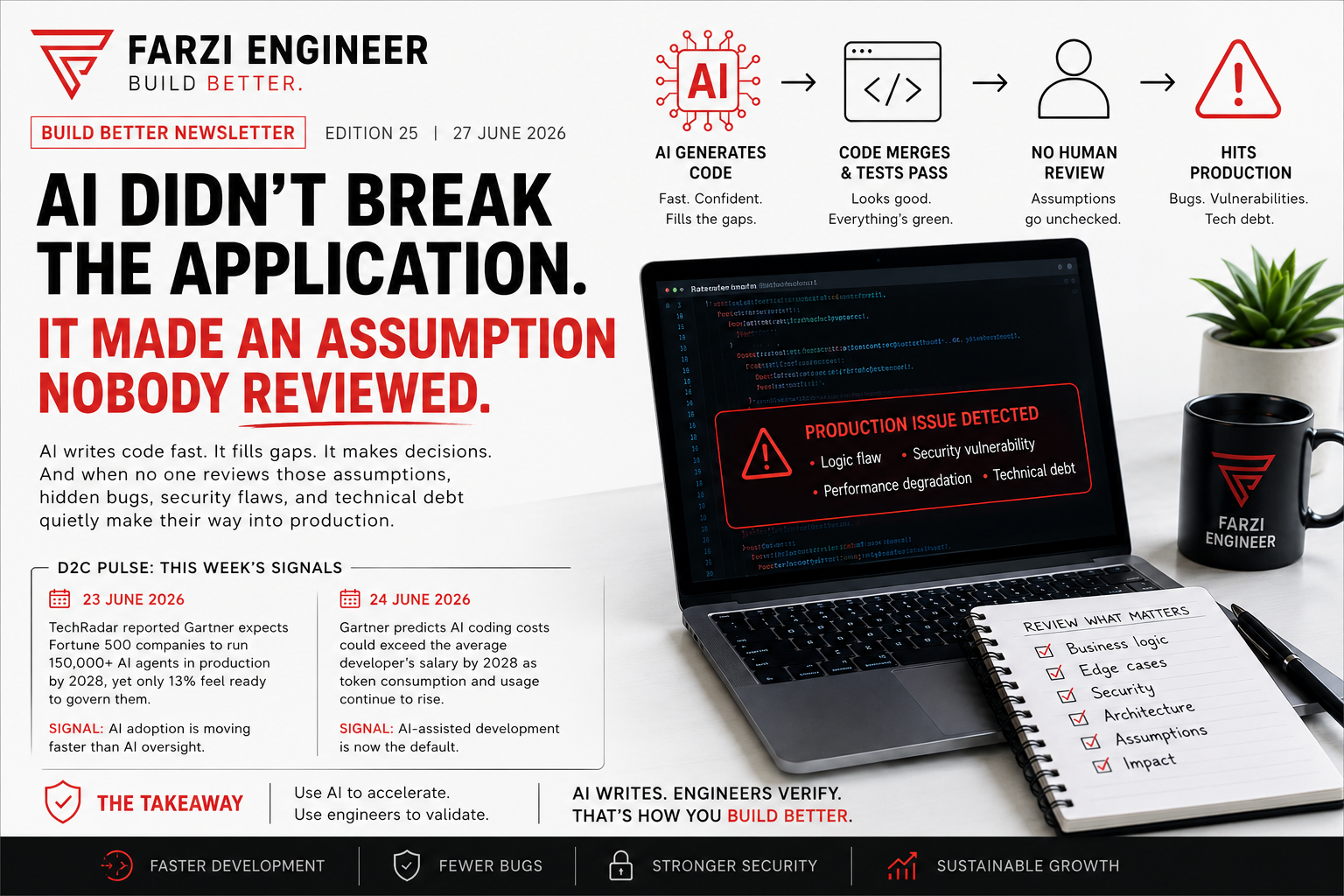
AI didn’t break the application. It quietly made an assumption that nobody reviewed.
That’s the failure mode more engineering teams should be paying attention to.
Summarize this post in AI's:
Not a dramatic hallucination.
Not a failed deployment.
Just AI generating code for an edge case it didn’t fully understand, filling in missing requirements, or making implementation decisions that developers accepted without question.
It sounds harmless until those assumptions reach production. The code compiled. Tests passed, and the release went live without raising any obvious concerns.
However, the real problems appeared later, when those unchecked assumptions surfaced in production.
As a result, the team spent far more time debugging subtle issues than they had saved during development.
The problem isn’t AI. It’s what happens when AI generated code moves through the software development lifecycle without human review. AI is excellent at accelerating development. It isn’t responsible for validating business logic, architectural decisions, or production-critical assumptions.
In this edition:
- D2C Pulse: This week’s signals on AI governance and enterprise adoption.
- Case Study: When AI filled in the gaps, production paid the price.
- Decode: Why AI should accelerate software development not replace engineering judgment.
D2C Pulse: This Week’s Signals
News: TechRadar reported that enterprise AI is hitting a guardrail problem fast. Gartner expects Fortune 500 companies to have more than 150,000 AI agents in production by 2028, yet only a small minority feel ready to govern them.
Signal: AI adoption is moving faster than AI oversight.
Why it matters: If you plug AI into workflows before defining what it’s allowed to do when data is missing, unclear, or inconsistent, you don’t get automation. You get scaled uncertainty.
News: AWS launched new tools focused on making enterprise AI agents safer and more effective in production.
Signal: The market is shifting from “how do we deploy AI?” to “how do we control it once it’s live?”
Why it matters: That’s the real inflection point. The winners won’t be the brands using the most AI. They’ll be the ones using AI with the right review layers, approvals, and fallback logic built in.
Case Study: When AI Filled the Gaps, the Business Paid for It
A growing technology company introduced AI into its software development workflow to speed up code generation and reduce repetitive engineering tasks.
The problem wasn’t that the AI wrote bad code every time. It was when requirements were incomplete or edge cases weren’t clearly defined that the AI confidently filled in the gaps. It made assumptions.
Those assumptions made their way into production code, APIs, and backend services. Nothing failed immediately. The code compiled, tests passed, and deployments went through. But subtle logic flaws began surfacing unexpected behavior, security gaps, performance bottlenecks, and technical debt that became harder to trace over time.
The solution wasn’t to stop using AI. It was to introduce a human review layer wherever the AI’s confidence was low or business logic was involved. AI continued handling boilerplate code, refactoring, and repetitive implementation. Engineers focused on validating assumptions, reviewing critical logic, and making architectural decisions.
Decode: AI Is Useful. Blind Trust Is Expensive.
AI should absolutely be part of modern software development.
It can eliminate repetitive coding, accelerate development cycles, and help engineering teams ship faster.
More importantly, it frees developers to focus on architecture, critical thinking, and solving complex business problems instead of repetitive implementation.faster.
But there’s a line every engineering leader needs to draw.
AI should absolutely be part of modern software development.
It can eliminate repetitive coding, accelerate development cycles, and help engineering teams ship faster.
More importantly, it frees developers to focus on architecture, critical thinking, and solving complex business problems instead of repetitive implementation.
Don’t use AI as a silent replacement for engineering judgment in code that impacts security, business logic, or production systems.
Because one incorrect assumption might go unnoticed.
A thousand AI-generated assumptions become bugs, security vulnerabilities, technical debt, and costly production incidents.
Talk to us: https://farziengineer.com/contact-us/?utm_source=newsletter&utm_medium=email&utm_campaign=30
Reply here, no pitch, just a conversation.
Explore more:
Previous insight→[your designer didn’t misunderstand you, your brief did][Shopify b2g2 ][your Shopify store is not a competitive advantage], [Conversion rate optimisation strategy], [Sustainability is scaling. Trust isn’t.]