 ChatGPT
 Perplexity
 Claude

Connect with us
Let's build something that scales. Reach out or follow along.

Plix was losing customers mid-sale, not because the offer was bad, but because customers didn’t understand it. Instagram comments were flooding in: “I bought two, where are my two free products?”
Summarize this post in AI's:
The offer was B2G2. Customers assumed B1G1. Confusion was silently killing conversion.
In this edition:
Signal: More visitors, smaller baskets. Discounts are pulling people in, but not pushing them deeper into the cart.
Why it matters: Blanket discounts train customers to buy less and wait for sales. Structured offers like BXGY do the opposite; they reward customers for buying more. If your sales strategy isn’t engineered to increase cart depth, you’re leaving AOV on the table every time.
Signal: Paid acquisition is expensive. Cart conversion has never mattered more.
Why it matters: When you’re paying ₹180 to get someone to your store, a confused checkout experience is a direct loss. Every customer who doesn’t understand your offer and drops off is ₹180 gone. Offer clarity is now a CAC problem, not just a UX problem.
Signal: Showing customers how close they are to a reward works better than telling them the reward exists.
Why it matters: A static banner saying “Buy 2 Get 2 Free” is easy to ignore. A cart progress bar saying “Add 1 more product to unlock B1G1” creates urgency in the moment it matters most when the customer is already buying.
Signal: Customers are getting smarter and less patient with unclear promotions.
Why it matters: If your offer needs explaining, it’s already losing. Plix was seeing exactly these customers commenting that they bought two products expecting two free, not understanding they needed four in the cart. Confusion kills conversion silently.
Problem: Customers were buying two products expecting two free. The actual offer needed four. The gap between assumption and reality was causing cart abandonment and trust issues.
What was built: Two changes. First minimum cart threshold reduced from four to two, activating B1G1 without rebuilding the engine. Second, a step based progress bar is built into the cart itself.
How it worked:
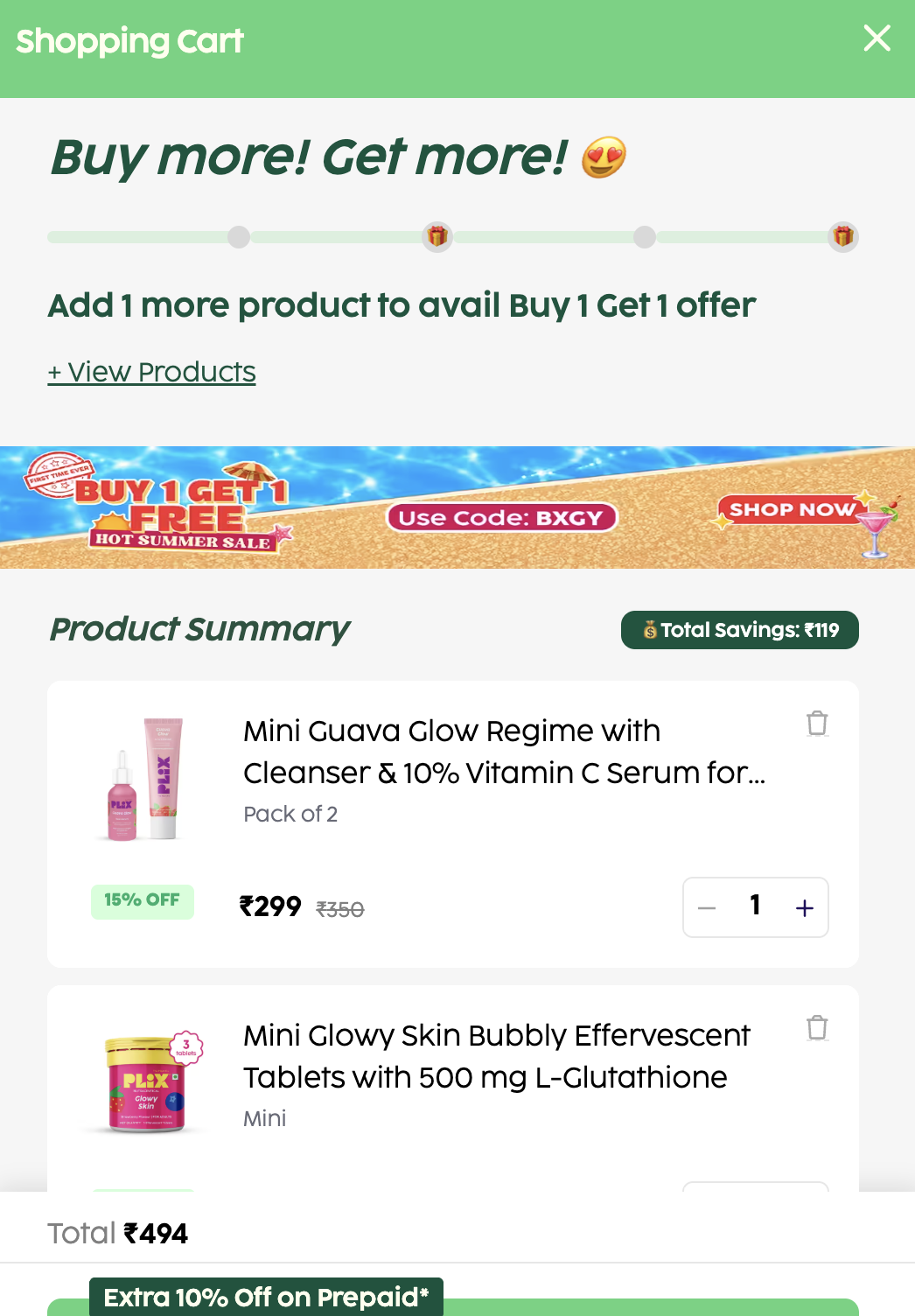
No coupon codes. No manual application. The offer applied itself.
Outcome: Customer confusion dropped. Cart depth increased. The sale ran cleanly — and the engine now handles any BXGY configuration with minimal development effort.
The offer didn’t change. The experience did.
Clarity beats generosity. A 50% discount that confuses the customer converts worse than a 20% discount with a progress bar showing exactly what to do next.
Audit your next sale: does the customer know, without reading a banner, exactly what they need to do to unlock the offer?
If not, fix that before you fix the discount percentage.
Building BXGY tiers or seeing drop-offs on sale days? Happy to exchange notes.
Reply here, no pitch, just a conversation.
Previous insight → [ your Shopify store is not a competitive advantage],[Conversion-rate-optimisation-strategy], [Sustainability is scaling. Trust isn’t.]



Comments are closed