 ChatGPT
 Perplexity
 Claude


Connect with us
Let's build something that scales. Reach out or follow along.
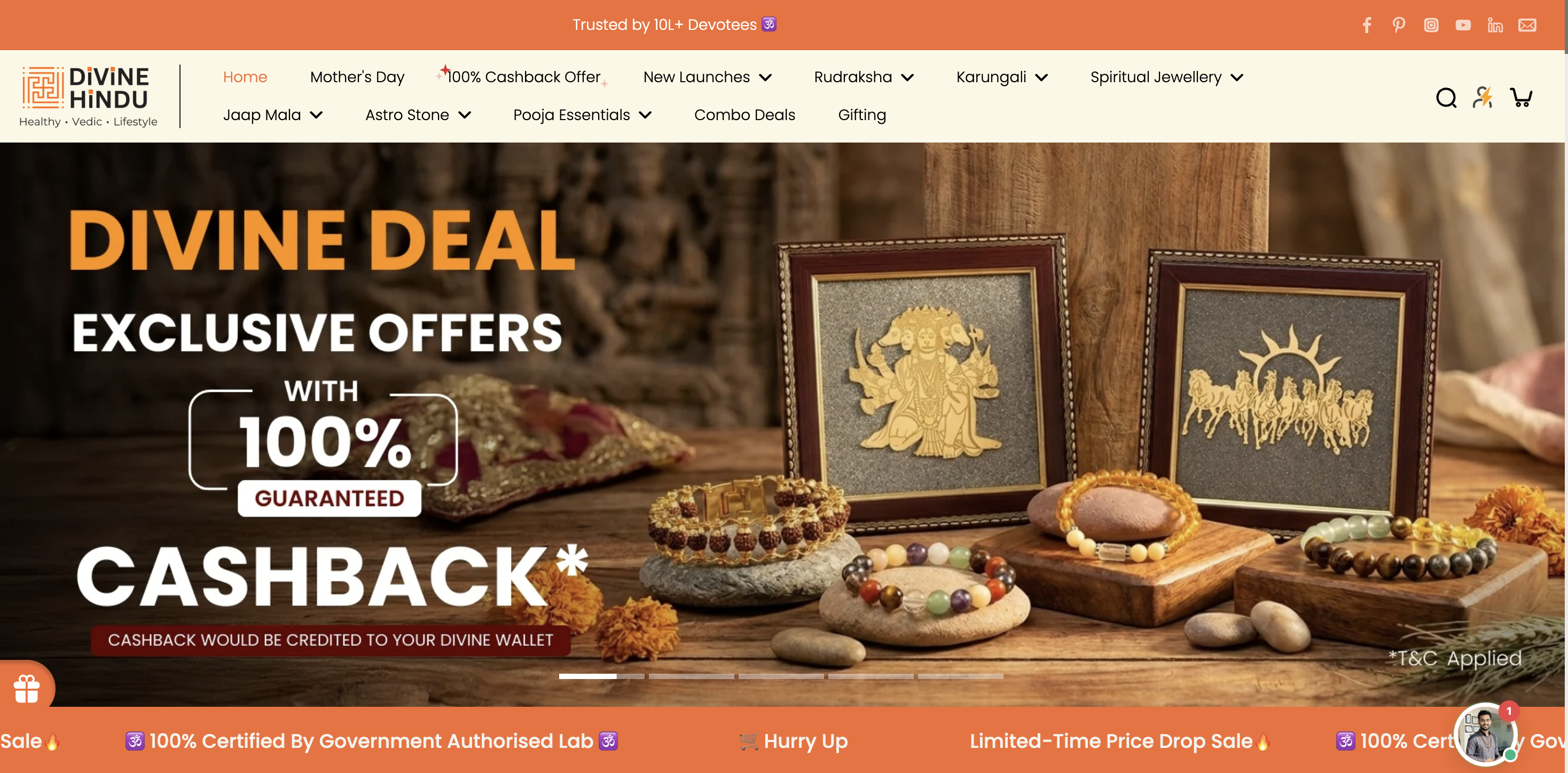
Every D2C brand reading this is on Shopify. Most of them look the same, load at the same speed, and hit the same ceiling, usually somewhere around ₹10–50Cr ARR, where the plugin stack starts cracking under pressure.
The brands that break through that ceiling aren’t doing more marketing. They’re rebuilding the foundation. This week, we’re pulling back the curtain on exactly how we did that for Divine Hindu, a devotional D2C brand that had outgrown what traditional Shopify could offer.
We moved them off Liquid templates and onto Shopify Hydrogen, a fully headless React stack. Here’s what that actually means, why it matters for your brand, and what the broader ecommerce world is signalling right now.
Summarize this post in AI's:
Shopify reported $3.2B in revenue for Q1 2026, up 34% year-over-year. Shop Pay alone processed $35B, up 59%. GMV crossed $100B for the second consecutive quarter.
Signal: Shopify isn’t slowing down its compounding. AI is now embedded into the core platform, not bolted on as an afterthought.
Why It Matters: The infrastructure you build matters. Shopify is becoming the default commerce OS for D2C brands globally. The question is no longer which platform it is, but how deep you go.
Shopify’s integration with ChatGPT went live in early April 2026. Consumers can now discover and complete purchases inside an AI chat without visiting your website.
Signal: Commerce is leaving the storefront. The next generation of discovery is conversational, not visual.
Why It Matters: If your product catalogue isn’t structured, API-ready, and headless-compatible, you simply cannot plug into this channel. Brands on rigid Liquid setups will be invisible here.
In 2026, mid-market D2C brands are adopting headless architecture as standard practice. The cost and complexity gap that kept it out of reach has largely closed.
Signal: What was a ₹2Cr+ enterprise project two years ago is now accessible to brands doing ₹10–100Cr in ARR.
Why It Matters: If you’re scaling, the question is no longer “should we go headless?” It’s “why haven’t we yet?”
B2B tools previously locked behind Shopify Plus are now available across basic, grow, and advanced plans at no extra cost.
Signal: Shopify is removing the feature moat between Plus and non-Plus merchants.
Why It Matters: Wholesale and bulk ordering just became viable for growing D2C brands without a costly plan upgrade. If you sell to retailers or bulk buyers, this changes your economics.
The Problem: DIVINE HINDUS’ invisible ceiling
Divine Hindu sells devotional and spiritual products, a category where trust, ritual, and emotional connection drive every purchase. The brand had strong product-market fit and a growing customer base.
On the surface, the store worked. Orders were coming in. The Shopify Liquid setup was live and functional.
But the problem wasn’t obvious. It never is at this stage.
We didn’t just rebuild a website. We rebuilt the commerce engine underneath it.
Divine Hindu sells devotional and spiritual products, a category where trust, aesthetics, and experience matter enormously. The old stack wasn’t delivering any of the three.
The previous Divine Hindu storefront ran on standard Shopify Liquid, the default templating system most Shopify stores are built on. It worked. But “works” is a low bar when you’re competing for a customer who has a dozen alternatives a Google search away.
The cart was the biggest pain point. It relied on a third-party cart solution that was duct-taped onto the storefront, limited customisation, inconsistent UX, and zero ability to build the interactive, brand-specific experience Divine Hindu needed.
We rebuilt it entirely on Shopify Hydrogen, Shopify’s official headless framework built on React, Vite, and GraphQL. The frontend is now completely decoupled from the backend. Shopify still handles products, orders, payments, and fulfilment, but what the customer sees and interacts with is 100% custom-built.
| Shopify Liquid (traditional) | Shopify Hydrogen |
| Frontend locked to Shopify’s template system | Full frontend freedom React, Vite, GraphQL |
| Fast to launch, painful to customise at scale | SSR, streaming, fine-grained data fetching |
| Third-party apps for every advanced feature | Cart built from scratch, no plugins, no limits |
| Limited control over Core Web Vitals & speed | Sub-second load times by architecture design |
| UI changes require dev involvement every time | Omnichannel ready: web, app, AI chat, voice |
Headless doesn’t make your business simpler. It makes your growth path simpler by removing the ceiling on what’s technically possible. The brands that move to headless in 2026 are building infrastructure that their competitors will spend 2027 trying to catch up to.
The result for Divine Hindu: a cart experience that actually reflects the brand, a storefront that loads fast on Indian mobile networks, and a codebase that can support the next 3 years of feature development without burning down and rebuilding every time.
If your team is hitting walls with customisation, cart UX, or checkout flows, this is the conversation worth having.
Want to see if headless is right for your brand? We’ve done it for Mamaearth, Plix, WOW Skin Science and now Divine Hindu.
Talk to us: https://farziengineer.com/contact-us/?utm_source=newsletter&utm_medium=email&utm_campaign=24
Explore more:
Previous insight → [Conversion-rate-optimisation-strategy] [Sustainability is scaling. Trust isn’t.]



Comments are closed