 ChatGPT
 Perplexity
 Claude

Connect with us
Let's build something that scales. Reach out or follow along.
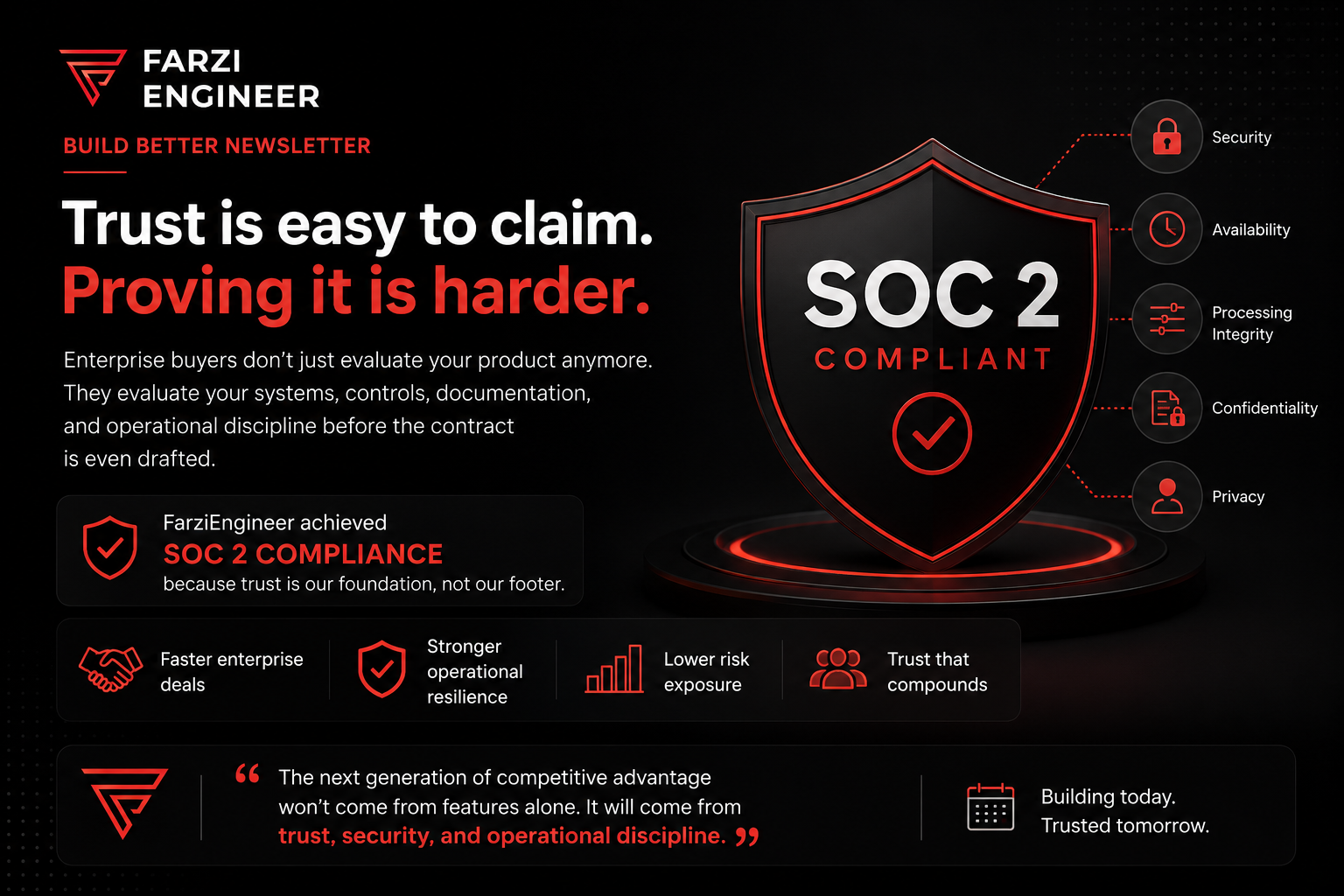
Enterprise buyers have changed. They’re not just evaluating your product anymore. They’re evaluating your systems, your controls, your documentation, and your operational discipline before the contract is even drafted.
Summarize this post in AI's:
Five years ago, a warm referral closed deals. Today, procurement teams send security questionnaires before the second call. Legal teams ask for compliance certificates before contracts move forward. IT teams run vendor assessments before access is granted. Trust used to be relational. Now it’s structural. The companies that understand this early aren’t just safer. They’re faster. They close deals quicker, face fewer procurement blockers, and build client relationships that compound over years, not just quarters.
FarziEngineer understood this. And they built for it before they were forced to.
News: Google acquired Wiz for $32B the largest acquisition in Google’s history. Wiz provides cloud misconfiguration detection and compliance control monitoring including SOC 2 visibility. The deal closed March 2026.
Signal: The world’s most valuable company just made compliance infrastructure its biggest-ever bet.
Why it matters: When Google spends $32B on a compliance and cloud security tool, it’s telling you exactly where enterprise procurement is heading. Security visibility is no longer a checkbox, it’s a core infrastructure layer. If Google is building it into their stack, your enterprise clients will expect it in yours.
News: In March 2026, a Y Combinator-backed compliance startup valued at $300M and trusted by over 1,500 companies was exposed for allegedly fabricating SOC 2.
Signal: Fake compliance is now a market scandal. Verified compliance is now a competitive moat.
Why it matters: Enterprise buyers are no longer accepting certificates at face value. When a procurement team asks for “your SOC 2,” they mean the PDF under NDA not a logo on your website. Real, independently audited proof is the only currency that holds up now. Shortcuts have consequences.
SOC 2 was never about a certificate for the website footer.
The realisation was simpler and more important than that. As FarziEngineer scaled, the operational risk of not having structured security controls was growing faster than the business itself. Access management was informal. Documentation was inconsistent. The incident response was reactive. These weren’t catastrophic problems today. But at enterprise scale, with more clients, more sensitive data, more infrastructure, they would become ones. The decision wasn’t compliance driven. It was growth driven. Build the trust infrastructure now, before a client asks for it, before a breach forces it, and before a procurement blocker costs a deal.
Over several months, the entire organisation worked through:
The result was a stronger operational foundation, not just a security certificate.
The business impact was immediate and compounding. Enterprise conversations that previously stalled at the security review stage began moving faster. The documentation was ready. The controls were verifiable. The independent validation was in place.
More importantly, internal operations became more resilient. The discipline required to pass SOC 2 forced better systems across the entire organisation. Access was tighter. Processes were cleaner. Risk was visible and managed.
Trust became a structural asset not a relationship variable.
Five years ago, trust came from referrals. Today it comes from proof. Enterprise buyers don’t want promises.
They want evidence.
Security controls.
Documentation.
Compliance.
Processes.
The companies that build those systems early move faster when larger opportunities arrive.
Trust is no longer a relationship advantage.
It’s an operational advantage.
Most companies wait until a client asks for security proof before they start building it. The best companies build it before the question is asked so when it comes, the answer is already ready. That gap between reactive and proactive is where enterprise deals are won and lost.
Building software for enterprise customers or scaling toward larger clients?
Happy to exchange notes on what the SOC 2 journey actually looks like in practice, what it costs, what it changes, and whether the timing makes sense for where you are.
Reply here. No pitch. Just a practical conversation.
The next generation of competitive advantage won’t come from features alone. It will come from trust, security, and operational discipline.
The companies building that foundation today are the ones closing the deals tomorrow.
Talk to us: https://farziengineer.com/contact-us/?utm_source=newsletter&utm_medium=email&utm_campaign=27
Previous insight→ [your Shopify store is not a competitive advantage], [Conversion rate optimisation strategy], [Sustainability is scaling. Trust isn’t.]



Comments are closed