 ChatGPT
 Perplexity
 Claude

Noida · Delhi NCR
125, First Floor A5, Block A, Sector 68, Noida – 201301
Get directions →
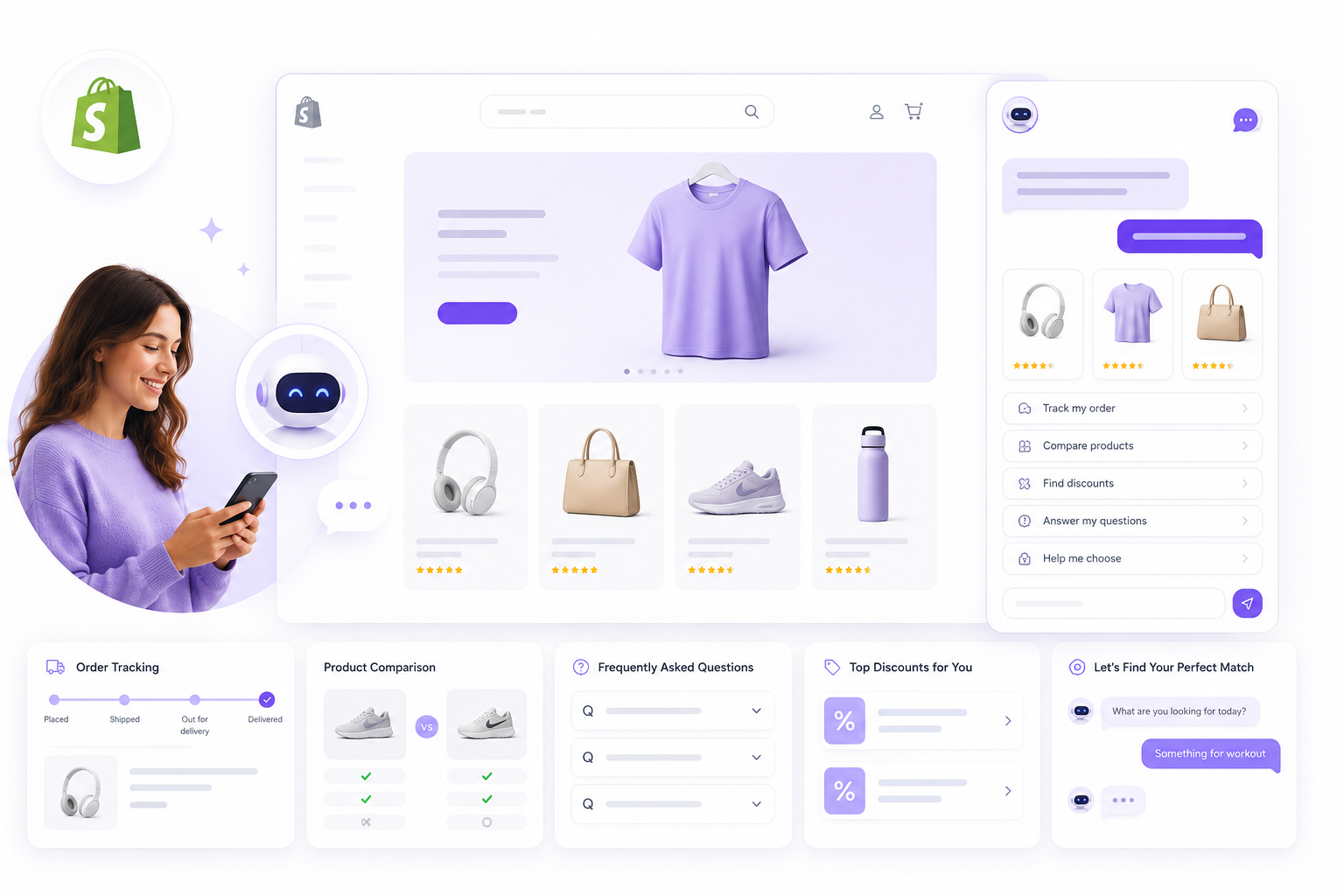
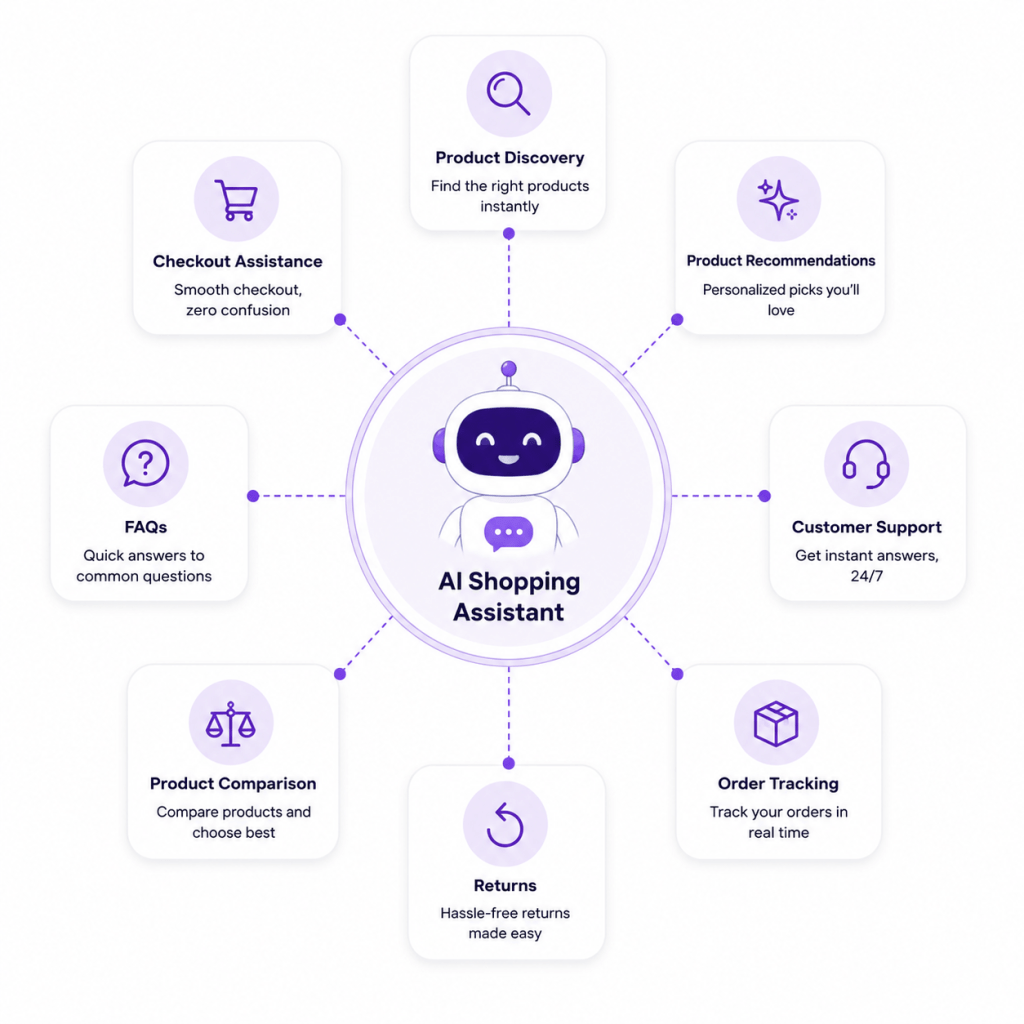
An AI Shopping Assistant for Shopify is an AI-powered assistant that helps customers discover products, answer questions, recommend items, compare products, track orders, explain return policies, and complete purchases automatically. Unlike traditional chatbots, modern AI shopping assistants understand customer intent and integrate with Shopify data in real time.
An AI shopping assistant is not a chatbot with better grammar. It’s a salesperson, support agent, and product expert working inside your Shopify store — connected to your live catalog, orders, and policies.
Shoppers abandon 70% of carts, and most of the reasons are answerable questions: shipping costs, returns, product doubts. An AI shopping assistant answers them in the moment, before the customer leaves.
The difference between tools that work and tools that disappoint comes down to two things: whether the assistant understands intent (buy vs. track vs. return), and whether it reads live Shopify data instead of static documents.
This guide covers how these systems work, what they cost in 2026, a comparison of the main options, and how we built our own — Shopbot Retainley — after watching document-only chatbots fail in real stores.
Here’s a number that should bother every Shopify store owner: 70.22% of shopping carts are abandoned. Seven out of ten people who liked your product enough to add it to their cart still walked away.
I’ve spent 7+ years in ecommerce and consulted for over 100 online stores. When I dig into why customers leave, it’s rarely dramatic. They couldn’t find the right size. They weren’t sure if the product would suit them. They had a question about returns and nobody answered. They wanted to compare two products and the site made that hard.
In a physical store, a decent salesperson handles all of this in thirty seconds. Online, most stores offer a search bar, a FAQ page, and a contact form that replies “within 24–48 hours.” By then, the customer bought from someone else.
That’s the gap AI shopping assistants exist to close.
This guide is everything I know about them — what they are, how they work under the hood, what they cost in 2026, which tools are worth your money, and the mistakes I see stores make. I build these systems for a living (my team built Shopbot Retainley, and our production deployment at DivineHindu handles real customer traffic daily), so this is written from the trenches, not from a marketing deck.
One promise: I’ll be honest about where competitors are strong, where AI still falls short, and who shouldn’t buy one of these tools.
The easiest way to misunderstand an AI shopping assistant is to think of it as “a chatbot, but with AI.”
It’s not. A chatbot answers questions. An AI shopping assistant helps people buy.
Think of it as five roles combined into one system living inside your Shopify store:
A salesperson. When a customer says “I need a gift for my mother under ₹2,000,” it doesn’t return search results. It asks a follow-up or two, then recommends three specific products from your live catalog — in stock, in budget.
A support executive. “Where’s my order?” gets answered with actual tracking data from Shopify’s order API, not a link to a help article.
A product expert. “What’s the difference between these two moisturizers?” gets a real comparison — ingredients, skin type, price — built from your product data.
A store guide. It knows your shipping zones, your return window, your COD policy, and your current offers, and it answers policy questions in plain language.
A shopping consultant. It remembers context within the conversation. If a customer asked about blue joggers two messages ago, “do you have them in XL?” means blue joggers in XL.
The defining trait is that it’s connected to live store data. Inventory, prices, orders, policies. A chatbot that answers from uploaded PDFs can tell customers what your return policy said three months ago. A shopping assistant tells them whether the product in front of them is in stock right now.
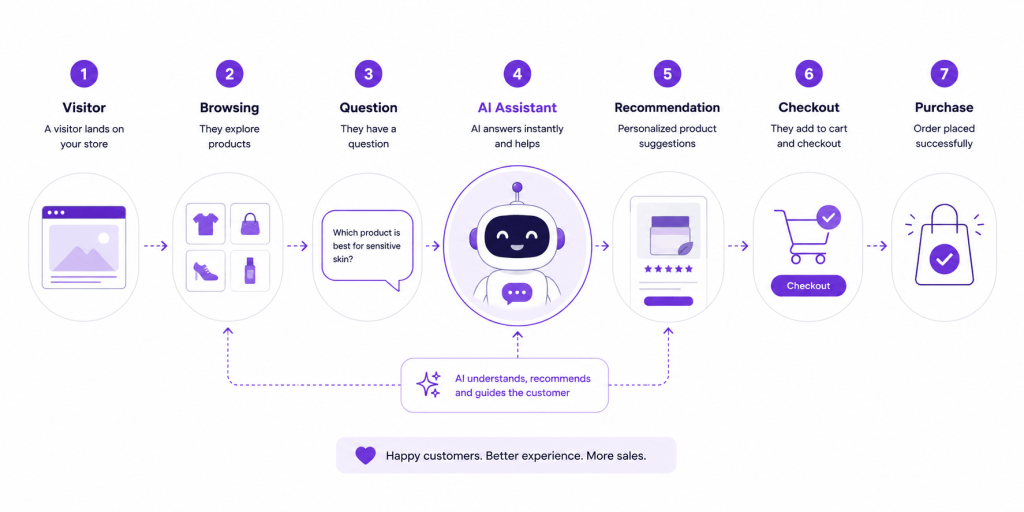
You don’t need to be an engineer to buy one of these tools, but understanding the moving parts will save you from buying the wrong one. Here’s the plain-language version.
When a customer types a message, four things happen in sequence.
First, intent detection. The system figures out what the customer is actually trying to do. “Where’s my order?” is a tracking request. “Something for oily skin under ₹500” is product discovery. “This arrived damaged” is a support escalation. Getting this classification right is the single most important step — everything downstream depends on it.
Second, data retrieval. Based on the intent, the system fetches what it needs: products from your Shopify catalog, an order status from the order API, a policy from your knowledge base. Good systems pull live data; weak systems search a static document dump.
Third, response generation. A large language model (LLM) turns the retrieved data into a natural, conversational answer. Crucially, in a well-built system the LLM is constrained — it phrases the answer, but the facts come from your data, not from the model’s imagination.
Fourth, action or handoff. The assistant either completes the task (shows products, shares tracking, applies a discount code) or recognizes it’s out of its depth and hands the conversation to a human with full context.
The tools that disappoint usually skip step one and step four. They take every message, search some documents, and let the LLM improvise. That works in a demo. It fails on the tenth real customer who asks something the documents don’t cover. I wrote about this failure pattern in detail in Why Most RAG Chatbots Fail in Production.
Let me make the case with numbers first, then with what I see in actual stores.
Cart abandonment sits at 70.22% on average, and 80% on mobile (Baymard Institute). Baymard’s research on why people abandon reads like a list of unanswered questions: extra costs like shipping and taxes surprised them (48%), checkout was too long or confusing (22%), total cost wasn’t shown upfront (17%). Baymard estimates $260 billion in the US and EU alone is recoverable just by fixing these solvable issues.
On the revenue side, Salesforce research attributes up to 31% of ecommerce site revenue to product recommendations. McKinsey finds personalization typically drives a 5–15% revenue lift, and companies that do it well generate 40% more revenue from personalization than average players.
On the cost side, AI assistants deflect 40–70% of support inquiries and cut support costs by up to 30%. And 76% of online retailers have implemented or are planning conversational AI — meaning your competitors likely already have.
Statistics are abstract. Here’s what customers actually do. They leave because they:
Every single one of these is a conversation a competent assistant handles in seconds. That’s the case in one line: an AI shopping assistant converts your unanswered questions into completed checkouts.
These three get lumped together constantly, and the confusion costs merchants money. They are different tools solving different problems.
Live chat is a human behind a widget. Quality is high, but it only works when someone is online, it doesn’t scale, and every conversation costs staff time. If your traffic doubles, your support cost doubles.
A traditional chatbot follows scripts: decision trees, keyword triggers, canned replies. It works 24×7 and it’s cheap, but the moment a customer phrases something unexpectedly — which is most of the time — it loops back to “I didn’t understand that. Please choose an option.”
An AI shopping assistant understands intent, reads live Shopify data, and takes action. It’s the only one of the three that can recommend products, compare items, and check a real order status without a human involved.
| Feature | Live chat | Traditional chatbot | AI shopping assistant |
|---|---|---|---|
| Understands intent | ❌ (human does) | Limited | ✅ |
| Product recommendation | ❌ | Limited | ✅ |
| Product comparison | ❌ | ❌ | ✅ |
| Order status | Human looks it up | Basic | ✅ Live Shopify data |
| Returns | Human handles | Basic | ✅ |
| Personalized shopping | ❌ | ❌ | ✅ |
| Upselling / cross-selling | ❌ | ❌ | ✅ |
| Works 24×7 | ❌ | ✅ | ✅ |
| Cost per conversation | High (staff time) | Low | Low |
| Handles unexpected phrasing | ✅ | ❌ | ✅ |
One thing I tell every merchant: the best setups aren’t AI or humans. The assistant handles the repetitive 60–80%, and your team handles what needs judgment. More on human handoff below.
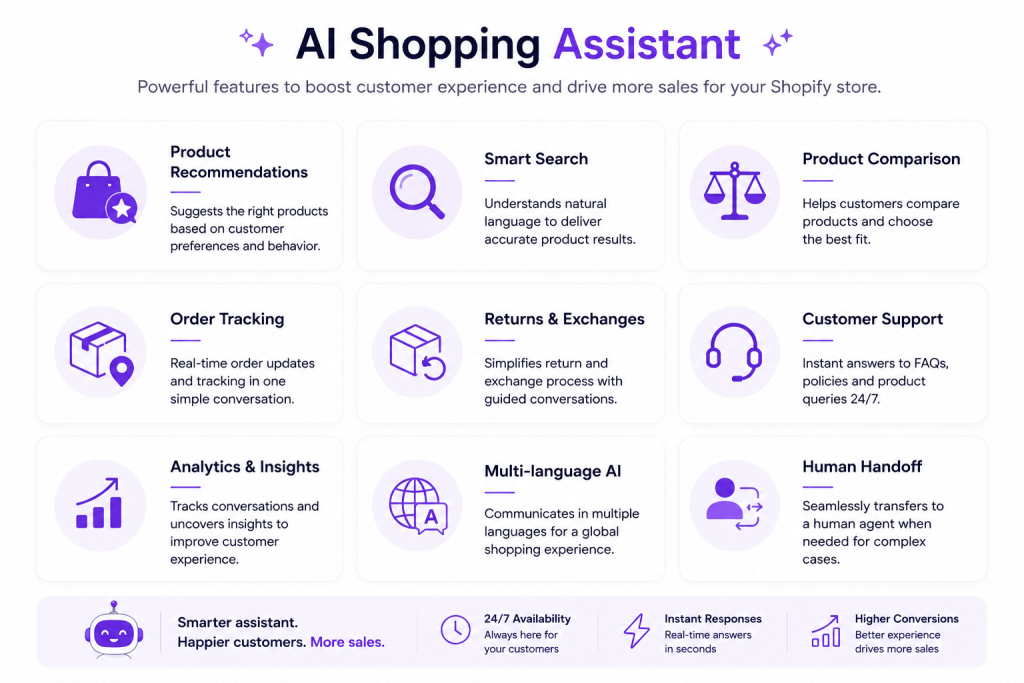
This is your buying checklist. If a tool you’re evaluating is missing more than two or three of these, keep looking.
The core revenue feature. The assistant should recommend products based on what the customer describes — “blue joggers under ₹1,400”, “a serum for acne-prone skin”, “a gift for a tea lover” — not just keyword matches. Recommendations should come from your live catalog, respect stock levels, and improve as the assistant learns what your customers actually buy. Remember: up to 31% of ecommerce revenue comes from recommendations.
Different from recommendation. Discovery is when the customer doesn’t know what they want yet. A good assistant asks one or two clarifying questions — occasion, budget, preference — and narrows the catalog conversationally. This is where AI beats a search bar: search demands the customer already knows the right keywords.
“What’s the difference between these two?” is one of the highest-purchase-intent questions a customer can ask. The assistant should compare price, materials, sizing, and features across products in a single answer. Very few tools do this well; it’s a strong differentiator to test in demos.
Policy questions, shipping times, size guides, product details. This is the volume workhorse — the 40–70% ticket deflection lives here. The key requirement: answers must come from your actual policies, not generic AI knowledge. Ask vendors how they prevent made-up answers.
“Where’s my order?” is the #1 support question in nearly every store I’ve worked with. The assistant must connect to Shopify’s order APIs and answer with real tracking status, not “please check your email for a tracking link.”
The assistant should explain your return window, eligibility, and process — and ideally initiate the return or hand off to your returns flow. Handled badly, returns questions become abandoned repeat purchases; handled instantly, they build trust that makes people buy again.
Customers leave your site to hunt for coupon codes and many never come back. The assistant should surface active offers, explain conditions, and — within rules you set — nudge hesitant buyers. You define the business logic; the AI should never improvise discounts.
Answering the last-minute questions that kill conversions: delivery dates, payment options, COD availability, shipping costs. Baymard’s data says 48% of abandoners left over unexpected extra costs — an assistant that answers “what’s the total with shipping?” before checkout removes that surprise.
Non-negotiable. When the customer is angry, the issue involves money, or the assistant isn’t confident, the conversation must route to a human — with full transcript and context, so the customer never repeats themselves. Any vendor that claims “you’ll never need humans again” is selling you a future complaint backlog.
Every conversation is market research. What are customers asking for that you don’t stock? Which products get compared? Where do people hesitate? Good assistants turn conversations into a dashboard of demand signals. This is the most underrated feature on this list.
The assistant should get better every week: unanswered questions flagged, knowledge gaps filled, recommendation quality improving from real outcomes. A static bot is a depreciating asset; a learning one compounds.
The technical foundation for everything above. Intent detection classifies what the customer wants before generating any answer. It’s why good assistants are fast, cheap, and accurate — and why document-only chatbots aren’t. If a vendor can’t explain their intent handling, that’s a red flag.
If you sell across regions — or in India, where customers switch between English, Hindi, and Hinglish mid-sentence — the assistant needs to follow. Modern LLMs handle this well, but test it with your real customer phrasing, not textbook sentences.
More conversions. Industry studies report 10–35% lifts in checkout conversion from conversational AI guidance and cart recovery. The mechanism isn’t magic — it’s answered questions. Every “does this ship by Friday?” answered in five seconds is a sale that doesn’t leak.
Higher average order value. Conversational recommendations create natural cross-sell moments: “customers who bought this kurta usually add this dupatta.” A search bar can’t do that; a salesperson-like assistant can.
Lower support costs. With 40–70% of inquiries deflected, your team’s time shifts from copy-pasting tracking links to handling the conversations that actually need a human. Support cost stops scaling linearly with traffic.
24×7 coverage without night shifts. Your store sells while you sleep; now it also answers while you sleep. For Indian D2C brands selling internationally, this alone justifies the tool — your US customers shop during your night.
Customer intelligence you can’t get anywhere else. Conversations tell you what analytics can’t: the exact words customers use, products they wanted but couldn’t find, objections that stopped them. I’ve watched merchants change their product pages, sizing guides, and even inventory decisions based on conversation analytics.
A better customer experience, honestly measured. Not because “AI is the future,” but because waiting 24 hours for an email reply is a bad experience and getting an accurate answer in half a second is a good one.
These are patterns from stores I’ve consulted for and from our production deployment at DivineHindu. Names of customers changed; questions are verbatim-typical.
The midnight gift buyer. “I need a rudraksha mala for my father, something authentic, under ₹3,000, delivered before next Thursday.” One message, three constraints. The assistant checks the catalog, filters by price and stock, confirms the delivery estimate for the customer’s pincode, and shows three options. Time to answer: seconds. Without the assistant: an email that gets answered the next afternoon, after the buying moment passed.
The anxious first-time customer. “Is COD available? What if it doesn’t fit? How do returns work?” Three trust questions before a first purchase. The assistant answers all three from actual store policy, in plain language. First-time buyer conversion is disproportionately about answered doubts.
The comparison shopper. “What’s the difference between the sandalwood and the tulsi mala?” The assistant compares materials, significance, care instructions, and price from product data. This customer was going to open two tabs, get confused, and leave.
The “where’s my order?” flood. Festival season, order volume triples, and 60% of tickets are tracking requests. The assistant answers every one instantly from Shopify’s order API. The support team of two survives Diwali.
The silent demand signal. Analytics show forty customers this month asked for a product variant the store doesn’t carry. The merchant now knows exactly what to stock next. No survey could have told them that.
Skip this section if you don’t care how the engine works. But if you’re evaluating vendors, ten minutes here will make you a much harder customer to fool.
Most “AI chatbots for Shopify” are architecturally the same thing: simple RAG. Upload documents, embed them, search them when a question comes in, let the LLM write an answer. It demos beautifully. It fails in production, because ecommerce questions aren’t document questions. “Where’s my order?” has no answer in any document — it needs an API call.
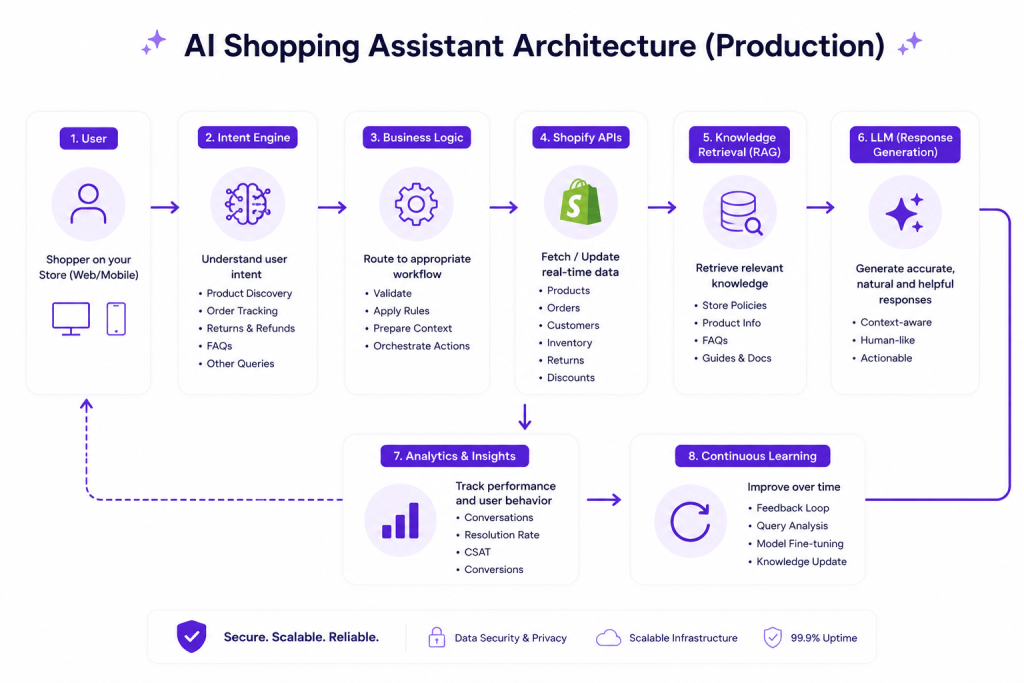
A production AI shopping assistant looks different. Here’s the pipeline we run:
Intent engine. Every message is first classified: product discovery, recommendation, comparison, order tracking, returns, policy question, complaint, chitchat. This happens before any AI generation. It’s fast, cheap, and it decides everything downstream.
Business logic. Each intent has rules. Tracking requests verify the customer and fetch the order. Discount questions check active offers against merchant-defined conditions. Complaints route to humans. The AI operates inside guardrails the merchant controls.
Shopify APIs. Live product data, live inventory, live orders, live pricing. Not a snapshot from onboarding day. When a product sells out at 2pm, the assistant knows at 2pm.
Knowledge base. Policies, size guides, FAQs, brand information — versioned, structured, and curated. I’ll be blunt: most of my early failures were bad source docs, not bad models. Garbage knowledge in, confident garbage out.
LLM. The language model enters late in the pipeline, with retrieved facts in hand and a constrained job: phrase the answer well. It’s the voice, not the brain.
Analytics. Every conversation is logged, classified, and scored: answered or not, converted or not, escalated or not.
Learning loop. Unanswered questions become knowledge-base tasks. Failed intent classifications become training data. The system that shipped in January is measurably better by March.
The one-line summary: simple RAG answers questions about documents; a shopping assistant runs a pipeline — intent → business logic → live data → constrained generation → learning.
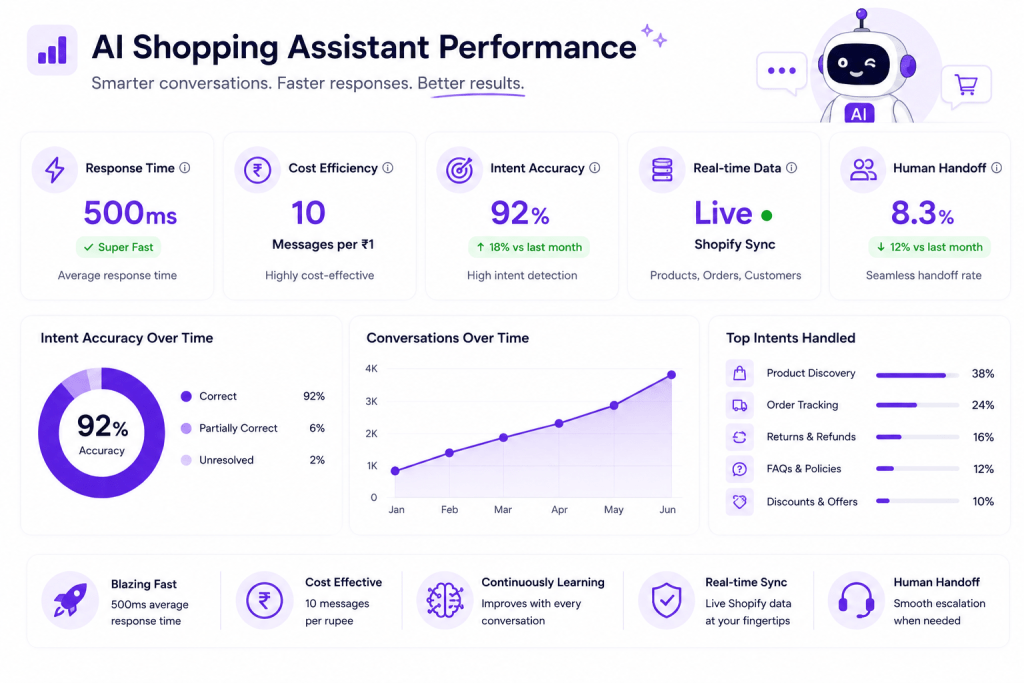
Here are the numbers we hold ourselves to on Shopbot Retainley, and why each one matters when you’re evaluating any tool.
~500ms response time. Because intent routing sends most queries through business logic and APIs instead of a full LLM round-trip, answers land in about half a second. Speed isn’t vanity — a customer mid-checkout won’t wait eight seconds for a shipping answer.
Intent routing accuracy. When intent classification is right, everything downstream is right. We track it obsessively because a misrouted “this arrived broken” that gets product recommendations instead of a human is how you lose a customer permanently.
Low hallucination by design. Factual queries — orders, prices, policies — never rely on the LLM’s memory. They’re answered from APIs and structured data. The model can’t invent a return policy it was never allowed to write.
Real-time Shopify data. Stock, price, and order status are fetched at answer time. No sync lag, no “sorry, that was yesterday’s inventory.”
Context memory. The assistant remembers the conversation. “Do you have it in XL?” works because it knows what “it” is.
Human escalation. Measured, not just promised: what percentage of conversations escalate, how fast, and with what context attached.
Continuous learning. Week-over-week reduction in unanswered questions is the health metric I’d ask every vendor to show you.
A short honest story.
After years of consulting for ecommerce stores, my team kept seeing the same thing: merchants would install an AI chatbot, get excited for two weeks, and quietly turn it off by month two. When we dug in, the pattern was always the same. The chatbot stopped at document retrieval.
Ecommerce doesn’t stop there. Customers ask about products. Shipping. Returns. Discounts. Comparisons. Bundles. Order status. They ask in Hinglish at midnight with three constraints in one sentence. A document-search bot answers none of that — it just apologizes in fluent English.
So we built an AI shopping assistant instead of another chatbot: an intent engine first, business logic second, live Shopify data third, and the LLM last — as the voice, not the brain. We run it in production (you can see it live at DivineHindu), we watch real customer conversations daily, and the learning loop from those conversations is the product’s real moat.
That’s the origin story. The rest of this guide stays vendor-neutral — including the comparison below, where I’ll tell you when a competitor is the better fit.
Pricing in this market is genuinely confusing, so let me decode the three models you’ll encounter.
Per-seat / flat monthly. Predictable, good for stable volume. Typical mid-market range is $100–$400/month.
Per-resolution / per-interaction. You pay for each conversation the AI handles. Sounds fair, gets expensive fast: Gorgias charges $0.90–$1.00 per AI interaction on top of ticket fees — at 1,000 monthly interactions that’s $1,260–$1,400/month including the double-billed ticket cost. Intercom Fin runs about $1,980/month at 2,000 resolutions in AI fees alone. Always compute cost at your volume, at 2× your volume, and during your peak season.
Hybrid. A base fee plus usage. Most honest for growing stores, but read the overage rates.
Shopbot Retainley pricing is deliberately simple: flat monthly plans by message volume, no per-resolution fees, no double billing.
| Plan | Price | Messages / month | Products | Includes |
|---|---|---|---|---|
| Free | Free | 100 | 50 | All features — try it on your real store |
| Starter | $29/mo | 2,000 | 500 | Full bot customization, conversation history, email support |
| Pro | $79/mo | 10,000 | 2,000 | Priority AI responses, analytics dashboard, priority support |
| Max | $133/mo | 20,000 | 4,000 | Priority AI responses, analytics dashboard, priority support |
For comparison: 2,000 AI interactions on per-resolution pricing costs $1,800–$2,000/month on the enterprise tools above. The same volume on our Starter plan is $29. Flat pricing is only possible because intent routing keeps our cost per message low — and we pass that through rather than charging per resolution.
A rule of thumb I give merchants: if the assistant deflects even 40% of tickets and assists even 2% more checkouts, the math works at almost any price in the ranges above. Run your own numbers; don’t take mine.
I build a competing product, so read this section knowing that. I’ve still tried to be straight about where each tool is genuinely strong — some of these are the right choice for stores that shouldn’t buy ours.
| Tool | Best for | Strengths | Watch out for | Pricing (2026) |
|---|---|---|---|---|
| Shopbot Retainley | Stores that want sales + support in one assistant | Intent engine, real-time Shopify data, product discovery & comparison, conversation analytics, ~500ms responses, human handoff | Newer brand than the incumbents below — judge us on a demo, not on logo count | Free plan; paid $29–$133/mo by message volume |
| Shopify Sidekick | Every merchant (it’s included with Shopify plans) | Excellent merchant-side AI: admin tasks, reports, Flow automations. Usage up 385% YoY | It’s for you, not your customers — it doesn’t talk to shoppers on your storefront | Free with Shopify plans |
| Tidio (Lyro AI) | Small stores starting out | Easy setup, live chat + AI combo, free tier | Costs stack up at scale (typically $100–150/mo with Lyro); support-focused, light on shopping assistance | Free tier; paid from ~$29/mo + Lyro usage |
| Gorgias AI Agent | Support-heavy stores already on Gorgias helpdesk | Deep helpdesk integration, automates up to 60% of support | Per-interaction pricing double-bills (AI fee + ticket fee); it’s a support tool, not a sales assistant | Plans $10–$900/mo + $0.90–$1.00 per AI interaction |
| Intercom Fin | Large/enterprise stores with big support teams | Mature AI resolutions, strong analytics, Shopify Plus certified partner | Enterprise pricing (~$0.99/resolution; ~$1,980/mo at 2,000 resolutions); overkill for most D2C brands | Seat fees + ~$0.99 per resolution |
| Zendesk AI | Enterprises already standardized on Zendesk | Full helpdesk suite, omnichannel, mature workflows | Heavy setup, priced for enterprise, generic rather than ecommerce-native | Suite plans + AI add-on fees |
| Rep AI | Stores focused on conversion/sales chat | Sales-oriented “AI concierge”, shopper intelligence, Shopify-native | Sales-first focus; evaluate support depth and handoff for your ticket mix | Tiered monthly plans by traffic |
My routing advice: tiny store with a handful of tickets a day — start with Tidio’s free tier or even Shopify Inbox, and upgrade when volume justifies it. Enterprise on Zendesk already — their AI add-on may be the path of least resistance. Support-only need, no interest in sales assistance — Gorgias is solid if the per-interaction math works for you. If you want one assistant that both sells and supports, with transparent economics — that’s the gap we built Shopbot Retainley to fill, and I’d rather show you than tell you: book a demo.
The short version (a full step-by-step guide is coming as its own article):
You should seriously consider one if: you get 10+ support tickets a day and tracking/policy questions dominate; your catalog is large enough that customers struggle to find things; you sell when your team is offline (night traffic, international customers); your conversion rate suggests people browse but hesitate; or support headcount is your fastest-growing cost.
You probably shouldn’t buy one yet if: you’re doing under a handful of orders a day (fix traffic first — an assistant multiplies conversations, it doesn’t create them); your product pages and policies are a mess (fix the source content first, or the AI will fluently repeat your mess); or you expect to install it and never look at it again. These tools need a feedback loop, at least a little attention weekly.
That second list loses me sales, and I’m fine with that. A merchant who buys too early churns and tells others the category doesn’t work. It does work — at the right stage.
Buying a document chatbot for an ecommerce job. If it can’t call Shopify’s APIs, it can’t answer the #1 question your customers ask. This is the most expensive mistake on this list.
Feeding it garbage content. One thing I learned the hard way: most AI failures are bad source docs, not bad models. Outdated policies, contradictory FAQ answers, product descriptions written for SEO instead of humans — the assistant will repeat all of it confidently.
No human handoff. Letting AI handle an angry customer with a damaged ₹8,000 order is how you turn a refund request into a one-star review.
Judging it in week one. The learning loop needs a few weeks of real conversations. Evaluate at 30 and 60 days, on data.
Ignoring the analytics. Half the value is the demand intelligence in the conversations. If nobody on your team reads the unanswered-questions report, you bought half a product.
Not computing peak-season costs. Per-resolution pricing that’s fine in July can be brutal in Diwali/BFCM season. Model your peak month before you sign.
Zoom out for a moment, because the AI shopping assistant isn’t a widget trend — it’s one piece of a larger change in how people buy online.
For twenty years, ecommerce has asked customers to do the work: type keywords, apply filters, open tabs, read policies, compare specs. Conversational commerce flips that. The customer says what they want in their own words, and the store does the work — the way shopping has always worked offline.
You can already see the shift on both sides of the counter. On the merchant side, Shopify rebuilt its Winter ’26 Edition around agentic commerce, with Sidekick usage among merchants up 385% year over year. On the customer side, people increasingly start their shopping research inside AI assistants — asking ChatGPT or Claude “what’s a good serum for oily skin under ₹800?” before they ever reach a store.
Both trends point the same direction: the stores that win the next five years are the ones whose product data, policies, and expertise can be conversed with — by customers on the storefront, and by the AI agents shopping on customers’ behalf. An AI sales assistant on your Shopify store is the first practical step into that world, and the conversation data it collects is how you learn what your customers actually want in their own words.
I’ll go deeper on this in a dedicated article on conversational commerce. For now, the practical takeaway: this is a direction to invest in early, not a fad to wait out.
An AI shopping assistant is an AI-powered assistant inside an online store that helps customers discover products, get recommendations, compare items, track orders, understand return policies, and complete purchases. Unlike a traditional chatbot, it understands customer intent and works with live store data — inventory, pricing, and order status.
Yes. A traditional chatbot follows scripted flows or answers from documents. An AI shopping assistant detects what the customer is trying to do — buy, compare, track, return — and takes the right action using real-time Shopify data. A chatbot answers questions; a shopping assistant helps sell.
Yes, but it’s merchant-facing. Shopify Sidekick is an AI assistant inside the Shopify admin that helps you run your store — reports, automations, admin tasks. It doesn’t talk to your customers on the storefront. For customer-facing AI, you need a dedicated shopping assistant app.
Yes. A good assistant reads your live catalog and recommends products from natural-language descriptions — budget, use case, style, size — not just keyword matches. Salesforce research attributes up to 31% of ecommerce revenue to product recommendations.
Yes. Order status, shipping times, return policies, size guides, and product questions make up the bulk of ecommerce support volume, and AI assistants deflect 40–70% of these inquiries when connected to live store data.
Stores using conversational AI typically report 10–35% improvements in checkout conversion from real-time guidance and cart recovery. The mechanism is simple: fewer unanswered questions means fewer abandoned carts.
Yes, if the assistant is connected to Shopify’s order APIs. “Where’s my order?” is usually the single most common support question, and a properly integrated assistant answers it instantly with live tracking data.
Yes. Most serious tools, including Shopbot Retainley, work on all Shopify plans including Plus. Plus stores often benefit most, because their support volume and catalog size make manual handling expensive.
A modern assistant can compare two or more products from your catalog side by side — price, materials, features, sizing — in a single conversational answer. Traditional chatbots can’t, because they don’t understand the catalog.
Yes, within rules you define. It can surface active codes, explain offer conditions, or nudge hesitant buyers at checkout. The business logic should always be merchant-controlled — the AI should never improvise discounts.
No, and it shouldn’t. It handles the repetitive 60–80% of tickets so your team handles the cases that need judgment: refund disputes, complaints, VIP customers. Good assistants include human handoff by design.
In 2026: free tiers for tiny stores; roughly $0.90–$1.00 per AI interaction on tools like Gorgias; around $1,980/month at 2,000 resolutions on Intercom Fin. Flat-plan tools are far more predictable — Shopbot Retainley has a free plan and paid plans from $29 to $133/month by message volume. Per-resolution pricing gets expensive at scale — always check the math against your own ticket volume and peak season.
Modern LLM-based assistants handle dozens of languages, including mixed-language conversations like Hinglish. Test with your customers’ real phrasing before you commit.
About 500ms for routed intents — because intent detection routes most queries through business logic and Shopify APIs instead of sending every message to a large language model. That routing is also what keeps costs low enough for flat monthly pricing.
Intent detection identifies what the customer wants — buy, compare, track, return — before generating any answer. It makes responses faster and cheaper, dramatically reduces hallucination, and lets the assistant take actions instead of just producing text. It’s the clearest dividing line between production-grade assistants and demo-grade chatbots.
Any LLM can hallucinate if you let it answer from imagination. Production-grade assistants prevent this by grounding every answer in live store data and routing factual queries — orders, pricing, policies — through APIs and business logic rather than free-form generation.
Ready to add an AI shopping assistant to your Shopify store?
AI product recommendations · AI customer support · Order tracking · Human handoff — free plan available.
Install on Shopify Book a demo
Prefer WhatsApp? Get a free store audit
Ashutosh Kesharvani — Founder, Farziengineer
I’ve spent 7+ years in ecommerce and consulted for 100+ online stores. My team builds production AI shopping assistants for D2C and ecommerce brands — including Shopbot Retainley, live today at stores like DivineHindu. I write about what actually works in production, not what demos well.
Previously: Why Most RAG Chatbots Fail in Production



Comments are closed