ChatGPT
 Perplexity
 Claude

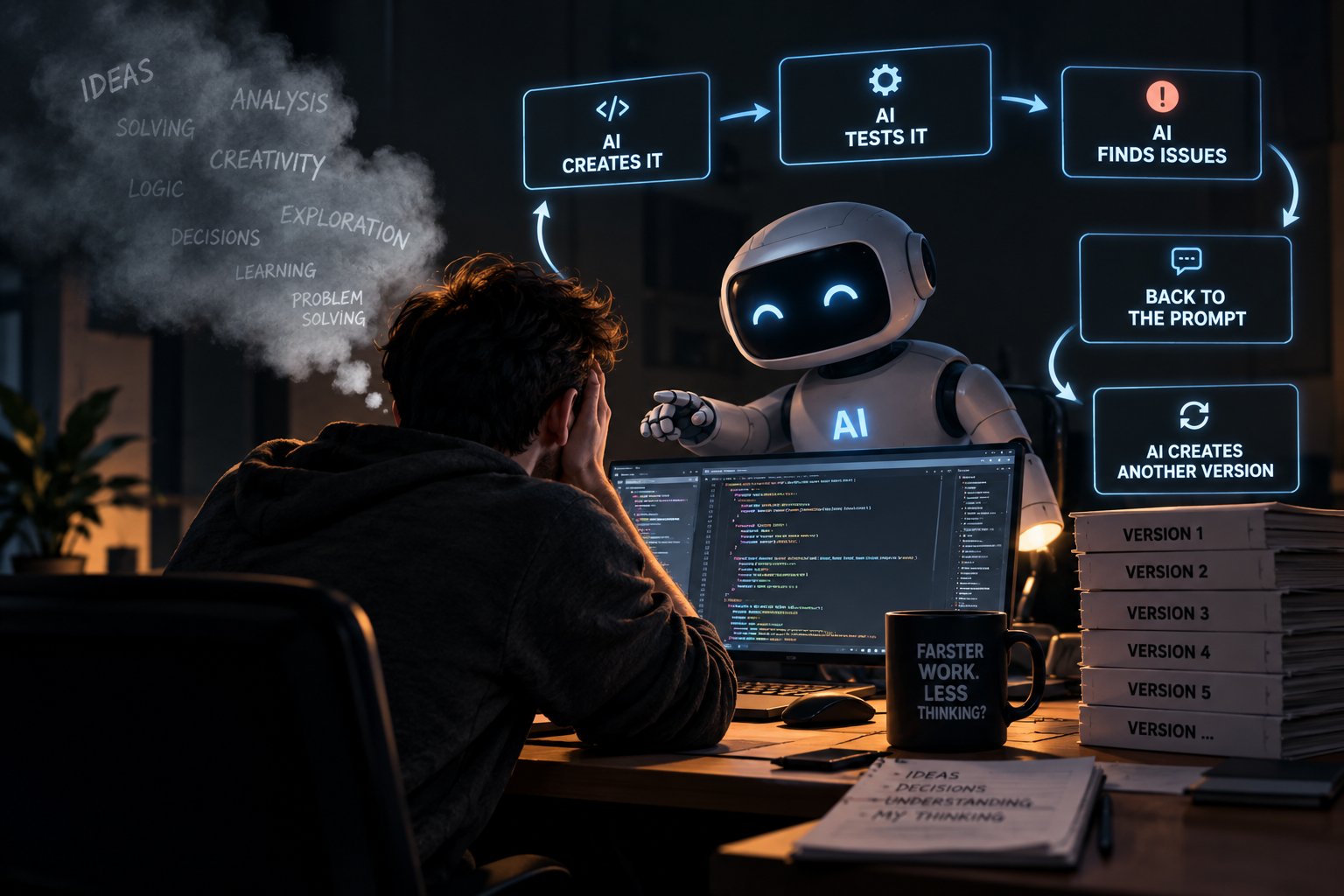
AI was supposed to help us think faster. Instead, we’re slowly reaching a point where people don’t want to think until AI has given them something to react to. Ask AI for an idea. Ask it to improve the idea. Ask it to find what’s wrong with it. Give those problems back to AI. Ask it to fix them. Then ask it to review the fix.
Summarize this post in AI's:
The work gets done.
But somewhere in that loop, the human becomes less of a creator and more of an approver. And that’s the part worth paying attention to.
D2C Pulse: This Week’s Signals
- AI code is reaching production: 46% of teams have shipped AI-generated code that later failed.
Signal: AI output still needs review.
Why it matters: Faster code means little if teams don’t understand what they’re shipping. - AI is coding more independently: AWS is pushing spec-driven development as AI agents increasingly generate, test and fix code themselves.
Signal: AI is moving from assistant to active developer.
Why it matters: The more AI does on its own, the more important clear requirements and human oversight become. - AI agents need monitoring: NVIDIA launched tools to monitor and control autonomous AI agents.
Signal: AI systems now need oversight of their own behaviour.
Why it matters: As AI gets more autonomy, “trust the output” isn’t enough anymore.
WHAT WE’RE SEEING
This is where the problem becomes very practical. Imagine a developer working on a client project. They ask AI to build a feature.
AI CREATES IT
↓
AI TESTS IT
↓
AI FINDS A FEW ISSUES
↓
THOSE ISSUES GO BACK INTO THE PROMPT
↓
AI CREATES ANOTHER VERSION
↓
AI TESTS IT AGAIN
↓
AI FINDS MORE ISSUES
↓
BACK TO THE PROMPT
↓
AI CREATES ANOTHER VERSION
↓
AND ANOTHER.
↓
AND ANOTHER.
Nothing is technically wrong with using AI this way. In fact, iterative AI-assisted development is becoming a serious area of software-engineering research. The problem starts when every iteration becomes regeneration instead of controlled evolution. Instead of understanding the existing implementation and changing what needs to change, we keep asking AI to produce the next version.
That’s when the burden quietly moves back to the human. Someone still has to review it. Someone still has to understand what changed.
Someone still has to make sure an old feature didn’t break.
And eventually, someone has to explain the system to the client.
AI can produce Version B very quickly. But it doesn’t automatically know whether Version B is actually better for the business.
DECODE: THE AI DEPENDENCY LOOP
The mistake isn’t asking AI to do the work. The mistake is allowing AI to become the entire workflow.
There’s a useful distinction here:
AI as a collaborator:
“I’ve thought about the problem. Give me alternatives, challenge my assumptions and help me execute.”
AI as a dependency:
“I don’t know how to approach this. Give me the answer.”
The first makes the human more capable. The second can slowly make the human less necessary to their own workflow. That’s why the strongest teams won’t simply be the teams using the most AI. They’ll be the teams that understand where AI should enter the process and where human judgment needs to remain.
USE AI TO
GENERATE POSSIBILITIES
—not decisions.
USE AI TO
FIND EDGE CASES
—not define what matters.
USE AI TO
TEST THE WORK
—not replace the review.
USE AI TO
CHALLENGE YOUR THINKING
—not do all the thinking.
USE AI TO
AUTOMATE REPETITIVE WORK
—not replace human judgment.
But keep the important decisions with someone who understands the product, the customer and the consequences of getting it wrong.
THE TAKEAWAY
We’re probably going to become much more productive because of AI. But productivity is only one metric. The more important question is: are we becoming more capable, or simply becoming better at operating AI? Because if AI disappeared tomorrow, the strongest teams should still be able to understand their product, solve problems and make decisions. AI should make your team faster. It should make your team more capable. It should give your people more room to think.
It shouldn’t become the thing doing all the thinking.
The goal isn’t to keep humans away from AI.
The goal is to make sure humans don’t disappear from the process.
Reach out directly:
https://farziengineer.com/contact-us/?utm_source=newsletter&utm_medium=email&utm_campaign=34
Explore more:
Previous insight→[how ai is changing project management][shopify spring 26 edition][ai code review best practice], [your designer didnt misunderstand you your brief di]